17 Father’s Day Crafts for Toddlers That Are Adorable
1. Handprint Tie Card
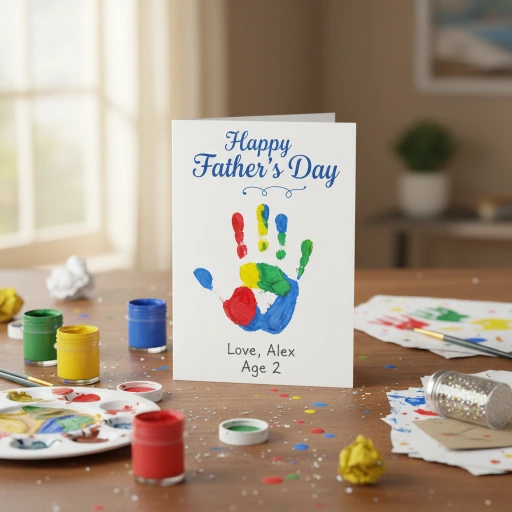
A handprint tie card — a piece of white or kraft cardstock folded into a greeting card format, the toddler’s hand painted in a solid bright color and pressed onto the front of the card in the specific orientation that makes the palm and fingers form the recognizable shape of a necktie, with “Happy Father’s Day” written in adult handwriting above or below the handprint and the child’s name and age recorded at the bottom — is the Father’s Day toddler craft that most cleverly and most charmingly uses the toddler’s hand itself as the creative medium for a recognizable, themed design that requires zero artistic skill from the child while producing a result of extraordinary personal charm and immediate emotional impact on the father who receives it. The handprint tie’s genius is its visual simplicity — the palm forms the tie’s widest lower section and the fingers together form the narrow upper shaft in a silhouette whose resemblance to a necktie is immediately apparent even to a viewer encountering the concept for the first time, creating the specific delight of a visual pun whose recognition produces genuine warm amusement rather than the forced appreciation that more labored craft concepts require.
Prepare the painting setup with the specific organization that makes painting with a toddler most manageable and most likely to produce a clean, legible result — covering the table with a plastic tablecloth or multiple layers of newspaper, having a wet cloth immediately accessible for the toddler’s inevitable hand-wiping impulses, and setting out only the single paint color needed for the handprint rather than the full palette of colors that will tempt the toddler into creative exploration that prevents the focused, single-impression technique that this craft requires. Apply the paint to the toddler’s palm using a sponge brush rather than having the toddler press their hand into a paint pool — the sponge brush application providing more even coverage across the full palm surface and preventing the excess paint accumulation at the creases and knuckles that pool-dipping produces and that creates smeared, indistinct impressions. Position the toddler’s hand on the card with the fingers pointing downward and slightly together — coaching older toddlers to hold their fingers close together while making the print, and simply positioning the hand correctly for younger children who cannot follow directional instructions during the brief window of paint application and pressing. Add a small triangular knot shape at the fingers’ base using a fingertip dipped in paint after the main handprint has dried.
2. Fingerprint Flower Bouquet Card
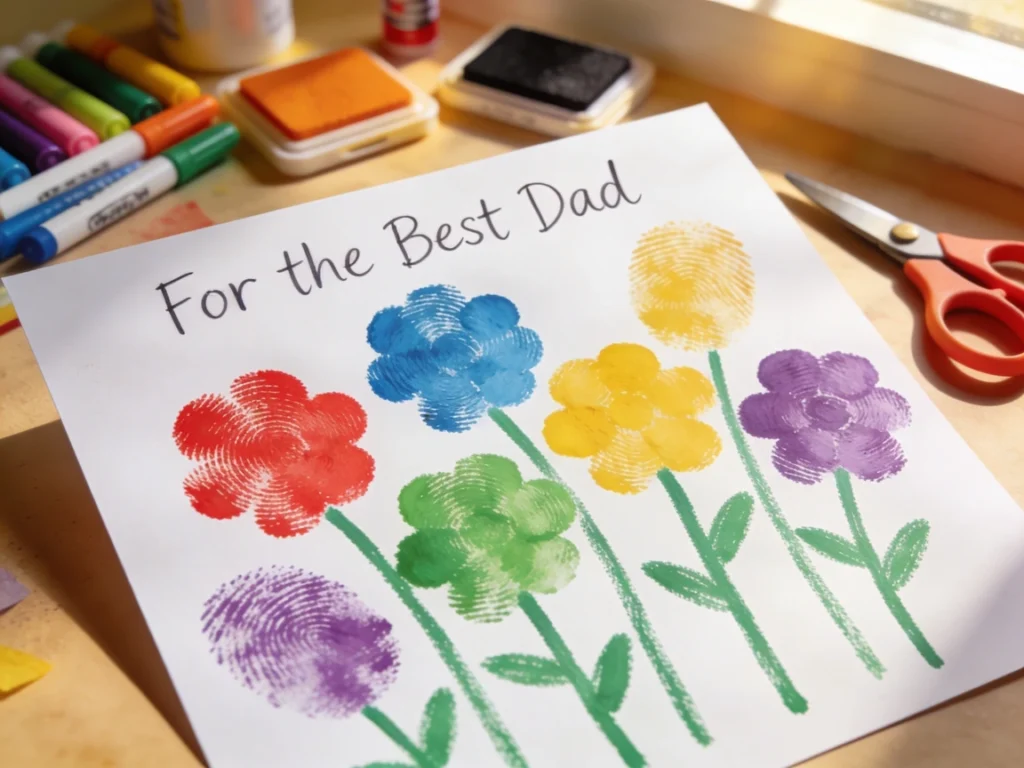
A fingerprint flower bouquet card — white cardstock on which the toddler presses individual fingers into different paint colors and stamps them in small clusters that form the petals and centers of stylized flowers, with the adult completing the design by drawing green stems and leaves connecting the fingerprint flowers into a finished bouquet composition, the card inscribed with “For the Best Dad” in adult handwriting above the bouquet — is the Father’s Day toddler craft that most joyfully and most colorfully celebrates the toddler’s specific manual dexterity stage — the ability to point with a single finger being one of the most celebrated developmental milestones of the toddler period — while producing a result of genuine visual appeal whose bright, multi-colored fingerprint flowers communicate the exuberance and the joy of a toddler’s engagement with color and mark-making in the most direct and most honest physical form available. The fingerprint flower bouquet is the Father’s Day craft that fathers most frequently describe as their favorite received gift — its tiny fingerprints communicating the toddler’s physical reality at this specific moment in time with a directness and specificity that no other craft medium can approach.
Set up the fingerprint painting activity with a shallow ink pad or small paint wells in multiple colors — the ink pad being particularly suitable for very young toddlers whose control over individual finger pressure is still developing, as the ink pad’s consistent surface provides uniform ink transfer regardless of the specific pressure the toddler applies, while paint wells allow more vivid color saturation for toddlers who have sufficient finger pressure control to make clean, distinct fingerprints rather than smeared marks. Guide the toddler toward making individual, distinct fingerprints rather than smearing or drag-printing by gently holding the toddler’s wrist during the pressing action — applying the finger to the paper surface with a light downward pressure and lifting cleanly rather than the lateral sliding motion that the toddler’s natural tendency to explore the paint’s texture on the paper surface produces. Complete the floral composition with adult-drawn stems and leaves immediately after the fingerprints have dried — the adult’s contribution being as minimal as possible while providing the connecting visual elements that transform individual fingerprint clusters into recognizable flowers with the specific charm of a child-adult collaborative artwork that neither could have produced independently.
3. Paper Plate Pizza “I Love You to the Moon” Craft
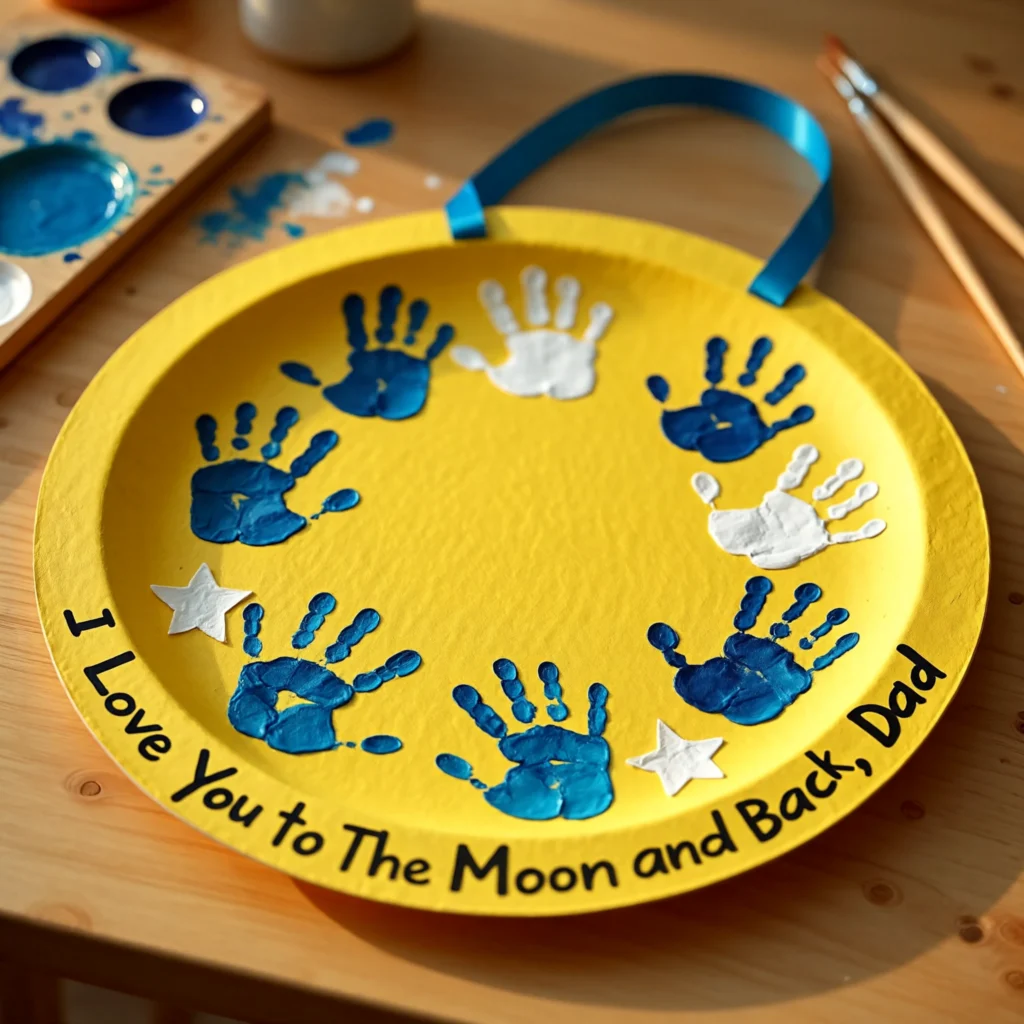
A paper plate moon and stars Father’s Day decoration — a round white paper plate painted yellow by the toddler with a sponge brush to create the moon’s circular form, surrounded by the toddler’s fingerprint stars in white and silver paint stamped around the plate’s perimeter, “I Love You to the Moon and Back, Dad” written around the outer edge in adult handwriting, a hole punched at the top and threaded with a length of yellow ribbon for hanging — is the Father’s Day toddler craft that most tenderly and most visually expresses the specific quality of toddler love for their parent through the iconic “moon and back” phrase that the toddler population’s most beloved bedtime book tradition has embedded in the cultural vocabulary of early childhood parent-child affection. The paper plate moon craft’s circular form, its glowing yellow color, and its surrounding constellation of tiny fingerprint stars creates a finished decoration of genuine visual warmth and cosmic charm that works beautifully as a bedroom or nursery wall decoration that the father will look at every night with the specific pleasure of a handmade object that carries within its paint and its paper the physical evidence of his toddler’s hands at a specific and irretrievable moment of their small life.
Paint the paper plate in the specific warm, slightly golden yellow that most convincingly represents a harvest moon rather than the cold lemon yellow that makes the finished decoration look more like a sun than the moon its title describes — mixing cadmium yellow or golden yellow with a very small amount of orange tempera paint to achieve the warm, amber-tinted yellow whose specific warmth communicates the cozy, glowing quality of moonlight rather than the cooler quality of sunlight. Allow the yellow plate to dry completely before adding the fingerprint stars — the wet paint underneath fully dry fingerprints providing the clean, distinct contrast between the yellow moon surface and the white star fingerprints that partially-dried paint undermines by lifting the yellow paint on the toddler’s finger and mixing it with the white star paint into an ambiguous, muddied color rather than the clean white-on-yellow contrast the design requires. Write the inscription in a font size appropriate to the available perimeter space — using a medium-point black or deep blue pen rather than a thick marker whose line width reduces the available character count and forces awkward abbreviation of the inscription’s full text.
4. Popsicle Stick Frame with Photo
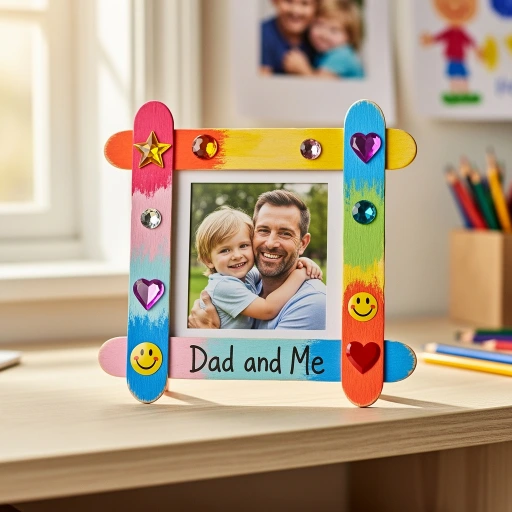
A popsicle stick photo frame — a square or rectangular frame constructed from multiple popsicle sticks glued together by an adult before the craft session and then decorated by the toddler with washable paint, foam stickers, adhesive rhinestones, and small decorative embellishments in any combination the toddler independently selects, with a printed photograph of the toddler and father together glued to the frame’s backing card — is the Father’s Day toddler craft that most immediately and most practically produces a finished object of genuine household utility, creating both a frame whose handmade character and toddler-decorated surface communicate genuine personal investment and a displayed photograph whose specific image content makes the father smile with recognition every time he encounters the frame on his desk, bedside table, or office shelf. The popsicle stick frame is the toddler craft whose materials are almost universally available, whose construction is achievable by any adult assembling the base structure in advance, and whose toddler decoration phase is genuinely within the creative and motor capability of children from eighteen months onward.
Construct the frame base before the craft session by gluing four doubled or tripled layers of popsicle sticks together in a square formation using strong craft glue — allowing complete drying overnight before presenting to the toddler for decoration, as a frame that is not fully cured before the decoration phase is handled and painted by the toddler risks the joint failures that separate the frame’s sides during decoration and that cannot be repaired cleanly after paint has been applied to all surfaces. Provide only non-toxic washable tempera paint in a small selection of the father’s favorite colors if known — limiting the palette to two or three colors that create a harmonious finished result rather than the full rainbow palette that most toddlers will enthusiastically mix into a uniform brown if presented with unlimited color options. Attach the photograph after the decorated frame has completely dried — using a piece of stiff cardboard cut to the frame’s interior dimensions as the backing, taping the photograph to the front of the backing card, and securing the backing card to the frame’s reverse with a strip of strong tape that creates a standing support when bent outward at forty-five degrees. Add “Dad and Me” written on the frame’s bottom stick in permanent marker before the decoration phase so that the inscription is part of the frame’s base layer rather than an afterthought applied over the toddler’s decorations.
5. Painted Rock “Super Dad” Paperweight
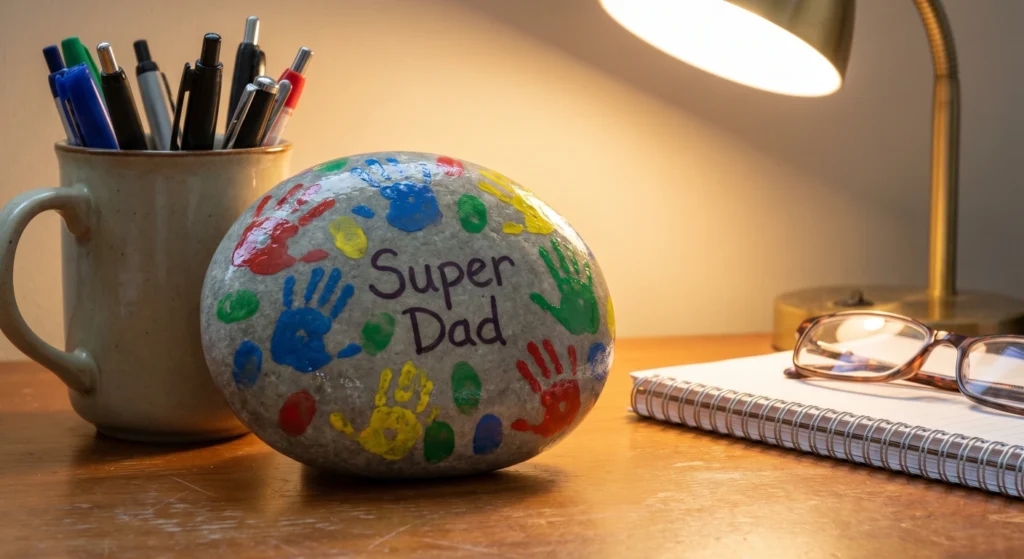
A painted rock paperweight — a large, smooth river stone decorated with the toddler’s handprints and fingerprints in multiple bright colors, “Super Dad” or “World’s Best Dad” painted in bold adult handwriting across the center of the stone when the toddler’s paint impressions have dried, then sealed with clear craft varnish for durability — is the Father’s Day toddler craft that most tangibly and most physically creates a gift that the father can hold, that has genuine weight, and that occupies the specific sensory presence of a real, substantial object whose stone coldness and smooth heaviness communicate permanence and the geological time scale against which the toddler’s bright, ephemeral paint marks create the most poignant possible contrast between the enduring material and the fleeting moment of a child’s hands at a specific age. The painted rock’s daily presence on the father’s desk as a functional paperweight ensures that this toddler craft is encountered and appreciated not once at the moment of gifting but continuously throughout every working day throughout the years the father keeps it on his desk.
Select the painting stone at a size and smoothness specifically appropriate for the intended function of a desk paperweight — a stone of approximately 200 to 300 grams that fits comfortably in an adult palm, with a surface smooth enough to accept paint without the paint absorbing immediately into rough stone texture, and a flat enough base to stand stably on a desk surface without rolling. Apply a white acrylic paint base coat to the stone’s upper surface before the toddler decoration session — the white base coat providing the light-reflecting ground that makes the toddler’s applied paint colors appear at their full, vivid saturation rather than the darkened, absorbed appearance that paint applied directly to the grey stone surface produces. Guide the toddler through making handprints and fingerprints across the base-coated stone surface with the specific patience and the specific speed that painting with a toddler requires — working quickly during the brief window of cooperative attention that a toddler maintains for any single activity before the impulse toward independent exploration takes over, and accepting the inevitable overlap, smearing, and color mixing as genuine features of the toddler’s mark-making rather than imperfections requiring correction. Apply three to four coats of clear gloss craft varnish after the paint has dried completely — each coat adding protection and building the glossy surface that transforms the painted rock from a fragile decorated stone into a durable, finished object.
6. Toilet Paper Roll Binoculars “Adventure Buddy”
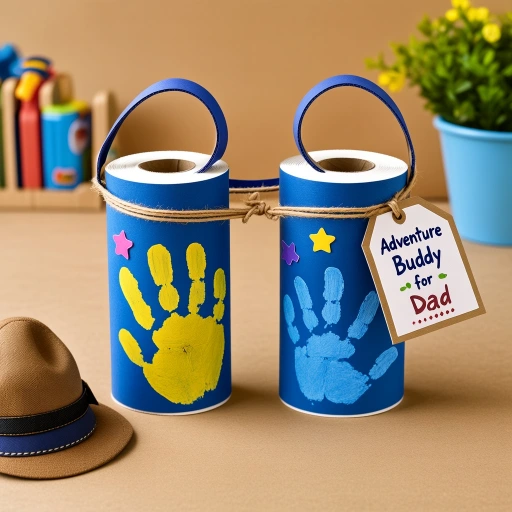
Toilet paper roll binoculars — two cardboard toilet paper tubes decorated by the toddler with tempera paint applied by hand, sponge, or brush and embellished with foam stickers, connected side by side with strong tape wrapped around their shared edge and a length of ribbon threaded through holes punched at their outer ends to create a neck loop, with a handmade gift tag reading “Adventure Buddy for Dad — For Exploring Together” attached with twine — is the Father’s Day toddler craft that most playfully and most imaginatively creates a functional object with a specific narrative of father-child adventure that makes the gift simultaneously a made thing, a play invitation, and a relationship proposition. The binoculars gift communicates a complete picture to the father: here is something your child made, here is an activity your child imagines doing with you, and here is an invitation to the specific quality of outdoor exploration together that children experience most joyfully when led by a parent who takes their discoveries seriously and shares their sense of wonder at the observable world.
Prepare the cardboard tubes with a layer of white gesso or white acrylic primer applied before the decoration session — the smooth, painted white surface providing the most effective ground for the toddler’s paint decorations and preventing the cardboard texture from showing through the final paint layers in a way that makes the finished binoculars look like decorated recycling rather than a genuinely finished craft object. Connect the two tubes securely using clear packing tape wrapped tightly around the shared contact edge for at least three complete circumferential wraps — the tape connection needing to be genuinely strong enough to survive the enthusiastic handling of an excited toddler who will want to immediately try out the binoculars upon their assembly, and whose physical use of the gift will test the connection’s integrity far more aggressively than the static display that most crafts experience after gifting. Write the gift tag text in the toddler’s voice rather than the adult’s — using the specific language the toddler uses to describe binoculars or looking at distant things, whatever words and phrases the individual toddler would choose if the craft’s conceptual narrative were translated into their authentic linguistic register rather than the adult-composed invitation that sounds appropriately gift-like but removes the child’s genuine voice from the object’s narrative identity.
7. Sponge-Painted Tie
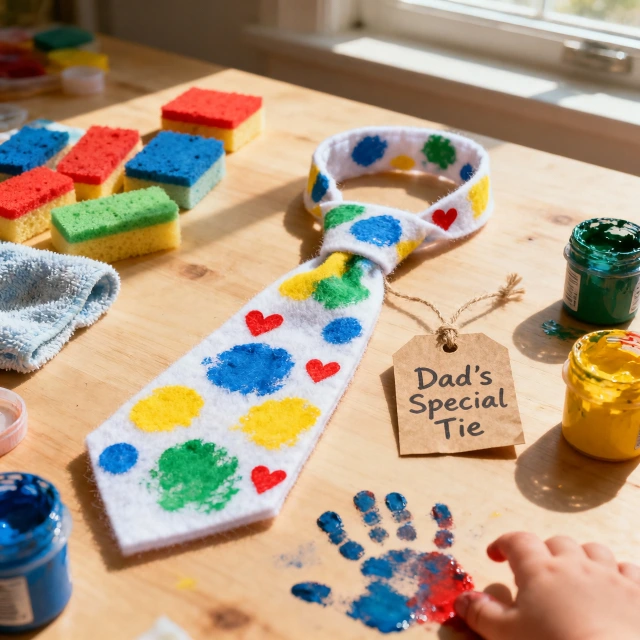
A sponge-painted fabric tie — a tie shape cut from white felt, heavy white fabric, or thick white card by an adult before the craft session, then given to the toddler for free-form sponge painting using small sponge pieces cut into geometric shapes, hearts, and stars dipped in multiple colors of fabric paint or acrylic, the completed tie displayed on a card or presentable backing with a tag reading “Dad’s Special Tie” — is the Father’s Day toddler craft that most enthusiastically celebrates the specific sensory pleasure of sponge printing — the toddler’s most developmentally appropriate painting technique at the eighteen-month-to-three-year age range, whose chunky sponge tool fits comfortably within the toddler’s whole-hand grasp and whose satisfying press-lift-repeat action is both motor-appropriate and genuinely pleasurable for the toddler who can repeat it independently and enthusiastically across the entire available surface. The sponge-painted tie is the craft whose creation is as joyful for the toddler as its reception is moving for the father — the happiness of the making process being as visible in the finished object as the toddler’s physical presence in its paint-covered surface.
Cut the small painting sponges from standard kitchen sponges using scissors — creating a heart shape by folding the sponge in half and cutting a curved incision, a star shape by cutting five shallow V-notches around a pentagonal form, and simple square or circular stamps from rectangular cuts — for the variety of print shapes that creates visual interest in the finished tie without the complexity of commercial foam stamp sets that are not necessary for this specific application. Set up the sponge painting with shallow trays of color — foam meat trays or repurposed plastic lids providing the perfect shallow paint tray depth for sponge loading, with a separate tray for each color to prevent the color mixing that a single shared paint tray produces and that eventually turns all colors into a uniform brownish-grey rather than the distinct, vivid individual colors that make the finished tie most visually appealing. Allow the toddler complete creative freedom during the sponge painting phase — resisting the adult impulse to direct the color choices, the placement of prints, or the density of coverage across the tie’s surface, as the toddler’s independent creative decisions are the specific artistic contribution that makes the finished tie genuinely theirs and genuinely theirs alone rather than an adult-directed production that happened to involve the toddler’s hands.
8. “All About My Dad” Questionnaire Art
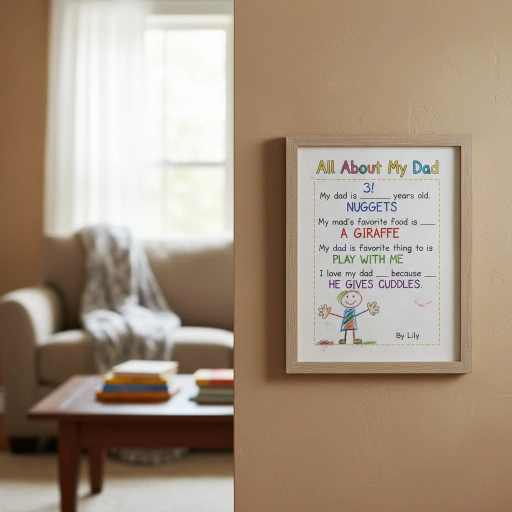
An “All About My Dad” questionnaire — a handmade or printed form with seven to ten questions about the father answered by the toddler through dictation recorded verbatim by the adult, including “My dad is __ years old,” “My dad’s favorite food is __,” “My dad is as tall as a __,” “My dad makes me laugh when he __,” “My dad’s superpower is __,” and “I love my dad because __,” completed with the toddler’s own drawing of their father in the space provided at the bottom — is the Father’s Day toddler craft that most genuinely and most hilariously captures the specific quality of a toddler’s knowledge, perception, and understanding of their father at this precise developmental moment, producing a document whose combination of factual inaccuracy, logical non-sequitur, and genuine emotional insight creates the most consistently entertaining and most deeply moving Father’s Day artifact available from any craft format involving a child under four years of age. The questionnaire’s specific value is its complete faithfulness to the toddler’s authentic voice.
Record the toddler’s answers with absolute fidelity to their exact words — never correcting the father’s age to its actual value from the toddler’s inevitably wildly inaccurate estimate, never improving the grammar of the toddler’s answer to a standard English formulation that removes the child’s authentic linguistic fingerprint from the document’s most important content, and never substituting a more sensible answer for the completely non-sensical response that the toddler’s literal, pre-logical developmental stage genuinely produces in response to a question whose conventional interpretation requires the cognitive capabilities of an older child. The father who reads that he is “fivety-hundred years old” and that his superpower is “making the remote control work” and that his favorite food is “the blue ones” will experience a specific quality of laughter and love that the accurate, grammatically correct version of the same questionnaire cannot generate at any equivalent emotional intensity. Present the completed questionnaire in a simple frame — the framing communicating that the document is genuinely valued and genuinely worthy of display in the home rather than an amusing novelty whose humor is sufficient justification but whose status as art requires the additional legitimacy of a frame.
9. Thumbprint Keyring
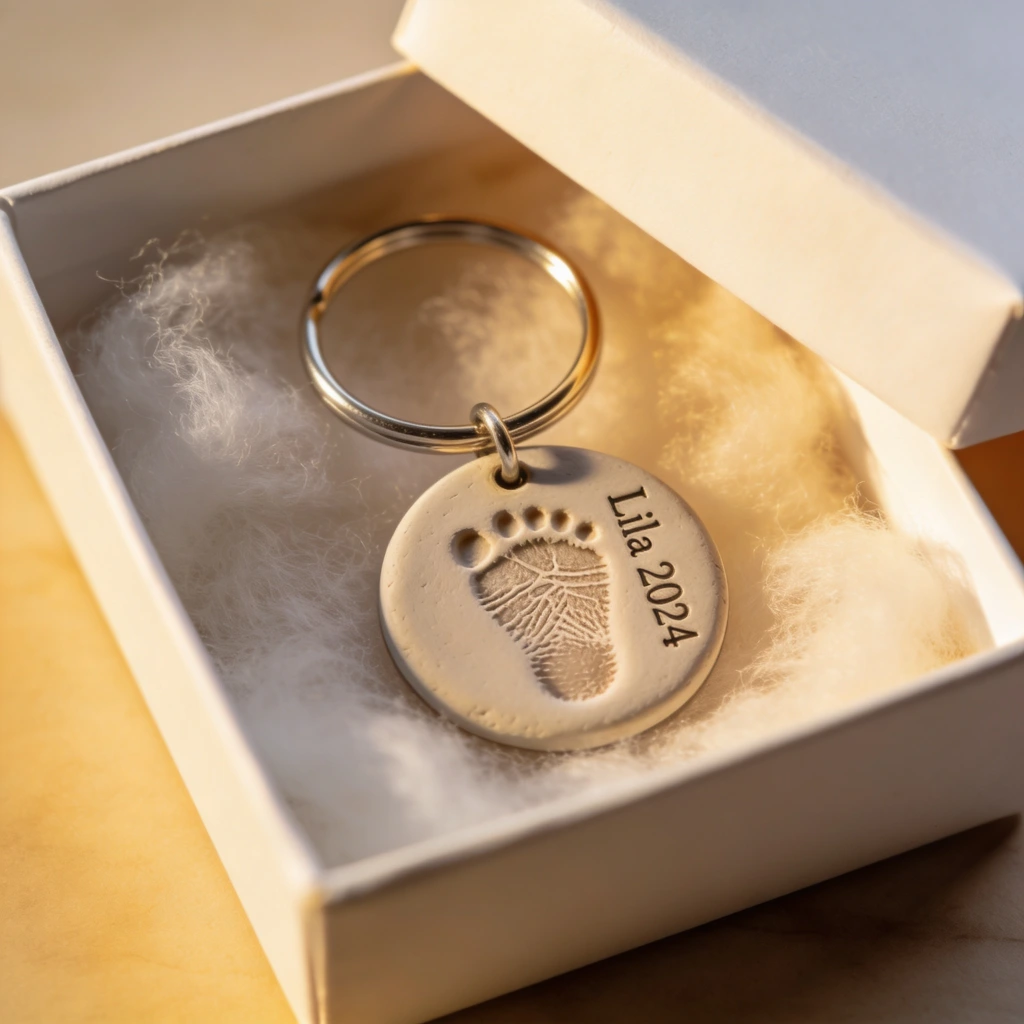
A thumbprint keyring — a small disc of air-dry clay or a commercially available metal clay stamping kit whose finished pendant carries the toddler’s thumbprint pressed clearly into the material, the child’s name and the year inscribed alongside the print, sealed and finished with a metallic paint or clay glaze, and attached to a quality key ring — is the Father’s Day toddler craft that most practically and most constantly accompanies the father through every day of his life from the moment of receipt, the keyring’s daily presence in the father’s hand during every car journey, every locked door, and every pocket-reaching moment creating the most reliably and most frequently experienced reminder of the toddler’s physical reality that any Father’s Day gift from any age group provides in any format. The thumbprint keyring is the toddler craft gift that the father carries for years — its physical presence in the hand communicating the toddler’s love in the most literal, most tangible, and most directly physical way that any gift format makes possible.
Work with air-dry clay rather than oven-bake clay for the thumbprint pendant if the commercial metal clay kit is unavailable — rolling a small ball of white air-dry clay to approximately two centimetres in diameter, flattening it into a disc of seven to eight millimetres thickness, and pressing the toddler’s thumb firmly and flatly into the centre of the disc for the complete, clearly defined thumbprint impression that the clay’s specific softness at the ideal working temperature most effectively captures. Create the ring hole before the clay dries — using a large drinking straw pressed through the disc near its upper edge to create a clean, round hole of sufficient diameter for the jump ring connection to the key ring, with the hole positioned close enough to the edge to leave adequate clay material around it that prevents the fragile air-dry clay from cracking along a thin section when the key ring’s weight applies leverage during daily use. Paint the dried pendant with a metallic acrylic paint — silver or gold — applied thinly over the entire surface and then immediately wiped away from the raised surfaces with a slightly damp cloth, leaving the metallic paint only in the recessed depth of the thumbprint impression itself for the antique-bronze highlighting effect that makes the thumbprint’s detail most dramatically visible and most visually striking in the finished keyring.
10. Bubble Wrap Printed Wrapping Paper
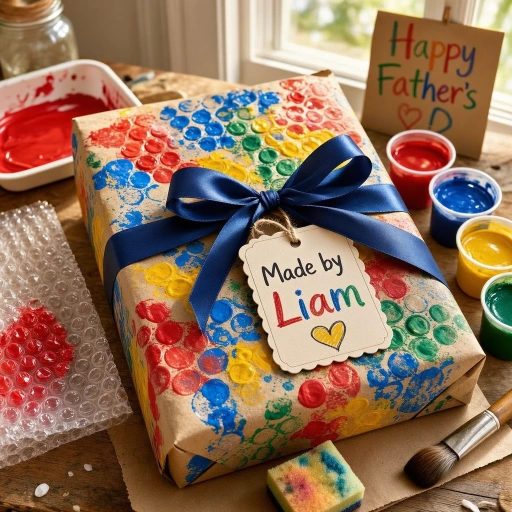
Bubble wrap printed wrapping paper — large sheets of kraft or white butcher paper across which the toddler rolls pieces of bubble wrap that have been painted with tempera paint on their bubble side, the paint-loaded bubbles transferring their circular pattern across the paper’s surface in an all-over repeat that creates genuinely beautiful, organically textured printed paper whose pattern is simultaneously controlled enough to be visually organized and variable enough to be handmade in character — is the Father’s Day toddler craft that most practically and most creatively transforms the gift wrapping requirement that every Father’s Day gift creates into a genuinely meaningful craft activity whose product both serves a practical function and communicates the toddler’s direct, joyful participation in the gift’s complete presentation rather than simply its card or its tag. The bubble wrap printed paper is a genuinely unusual and genuinely beautiful wrapping material whose texture and pattern make the wrapped gift the first impression of the complete gift-giving experience whose handmade quality sets the emotional register for the contents’ unwrapping.
Cut the bubble wrap into pieces of approximately 20 by 20 centimetres — a size that the toddler’s two-handed grip can manage for the rolling and pressing action that creates the print, and that covers sufficient paper surface area per print-making action to make the activity feel productive and satisfying for the toddler rather than the laborious individual stamp-pressing that smaller bubble wrap pieces would require for equivalent coverage. Apply paint to the bubble wrap using a foam roller rather than a brush — the roller’s uniform pressure ensuring even paint coverage across all bubble surfaces rather than the uneven distribution that a brush creates between the bubbles and the channels between them. Use the toddler’s favourite colors rather than specifically patriotic combinations for the wrapping paper — the personal color preferences of the individual toddler being a more genuinely child-created quality of the finished paper than the adult-directed patriotic palette that replaces the toddler’s genuine aesthetic agency with an adult’s thematic decision. Allow the paper to dry completely before using for wrapping — the wet paint that seems dry to the toddler’s touch being frequently still tacky enough to transfer onto the gift’s surface during wrapping and to stick to the tape and ribbon during the final presentation preparation.
11. Clay Fossil Impression Dish
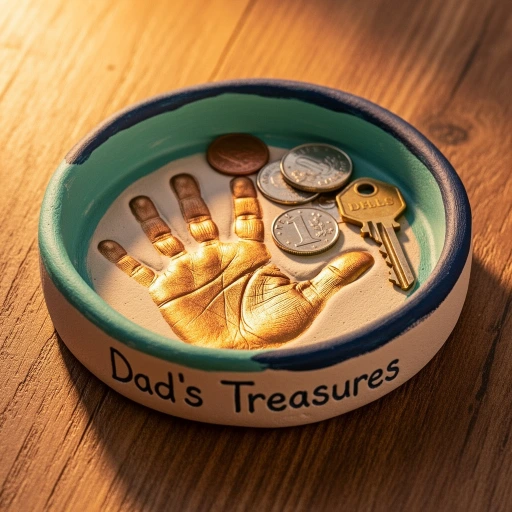
A clay impression dish — a shallow circular dish formed from air-dry clay by an adult, the toddler’s handprint pressed clearly into the dish’s interior base while the clay is still workable, the completed and dried dish painted with a metallic gold or copper paint that fills the handprint’s impression with warm, luminous color while the surrounding dish surface is painted in a coordinating matte tone, the outside of the dish lettered with “Dad’s Treasures” in adult handwriting — is the Father’s Day toddler craft that most beautifully and most functionally combines the craft tradition of the keepsake handprint impression with a practical object that occupies a useful place on the father’s desk or bedside table as a holder for coins, keys, cufflinks, or the small daily objects that accumulate without a designated home in any man’s immediate environment. The impression dish is simultaneously a piece of the toddler’s physical archive and a genuinely useful household object whose function justifies its permanent display in a way that a purely decorative keepsake does not always achieve.
Form the clay dish using the specific technique that creates the most professional-looking result from air-dry clay without a pottery wheel — rolling the clay to a uniform thickness of approximately eight millimetres using two guide sticks of equal height as thickness guides, cutting a circle of approximately fifteen centimetres in diameter using the rim of a drinking glass as a template, then draping the circle over a small upturned bowl or plate to create the gentle curved walls of a shallow dish while the clay is still flexible. Allow the clay to dry in the curved dish form for twenty-four to thirty-six hours before removing from the forming bowl — the clay needing sufficient drying time to hold its curved form independently before the forming support is removed. Sand the dried dish gently with fine-grit sandpaper to smooth any rough edges or surface irregularities before painting — the sanding step being the single most important preparation for a painted finish of professional quality, as unsanded air-dry clay surface produces a noticeably rougher painted finish that communicates less care and less quality than the smoothed surface achieves. Apply the metallic paint to the interior using a small brush that follows the impression’s contours precisely — working the paint into the depth of the handprint impression with the brush tip rather than the brush’s side, for the maximum metallic highlighting of the impression’s deepest point that makes the handprint most dramatically visible in the finished dish.
12. Paper Bag Puppet of Dad
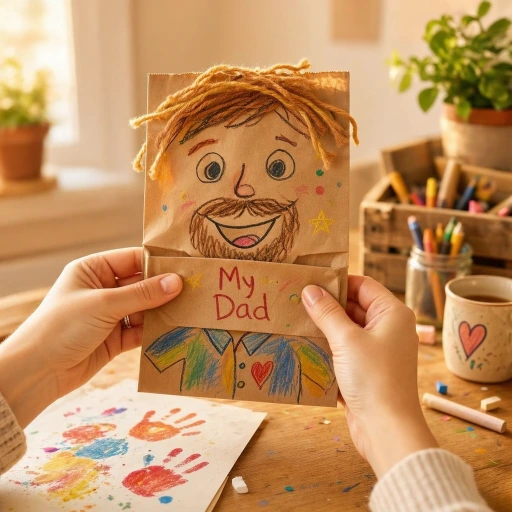
A paper bag puppet of dad — a standard brown paper lunch bag on which the toddler draws the father’s facial features using crayons or markers with adult assistance for the basic face shape placement, yarn pieces glued to the bag’s base flap for hair in the father’s specific hair color, a simple collar and shirt front drawn on the bag’s lower section, and the completed puppet photographed being used to deliver a greeting in the puppet’s voice — is the Father’s Day toddler craft that most playfully and most imaginatively engages the toddler’s beginning dramatic and imaginative play development by creating a specific character — their own father in puppet form — for whom they are genuinely motivated to engage in the face-making activity that drawing and assembling the puppet requires. The puppet’s specific genius as a Father’s Day craft is its invitation for the toddler to observe and represent the father’s specific physical features — requiring a level of attentive observation of the father’s face that is itself a profound act of love regardless of how accurately or inaccurately the resulting puppet captures its subject’s likeness.
Guide the toddler through the face-drawing process with questions that direct their observation rather than instructions that direct their mark-making — asking “where do we put daddy’s eyes?” rather than drawing the eye positions yourself, asking “what color is daddy’s hair?” rather than selecting the yarn color yourself, and asking “does daddy have a beard or a mustache?” rather than making that facial feature decision for the child — for the specific quality of child-directed representational art that captures the toddler’s genuine perception and genuine memory of their father’s physical appearance rather than the adult’s accurate representation imposed through guided hand-over-hand drawing. Accept and celebrate whatever facial configuration the toddler produces as a completely valid representational portrait — the eyes placed on the chin, the nose larger than the mouth, the hair represented by a single horizontal line across the forehead — as genuine evidence of the toddler’s current stage of visual memory and spatial representation that is far more personally meaningful as a portrait than any adult-corrected version could be. Perform a brief puppet show with the completed dad puppet before presenting the gift — using the puppet to deliver a Father’s Day message in a silly voice that makes the toddler laugh and that the father will hear about from the toddler’s enthusiastic description for weeks after the craft has been completed.
13. Marbled Paper Bookmark
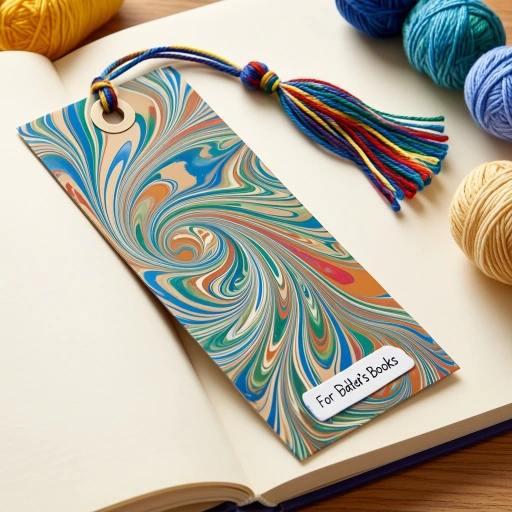
A marbled paper bookmark — a long, narrow card laminated after the toddler’s participation in the oil and water marbling process that creates the swirled, flowing color patterns of genuine paper marbling using only dish soap, water, oil-based paint or food coloring in cooking oil, and the toddler’s enthusiastic swirling action with a toothpick or thin stick, then laminated for durability and finished with a yarn tassel in the toddler’s chosen color attached through a hole punched at the top — is the Father’s Day toddler craft that most unexpectedly and most impressively produces a result of genuine visual beauty and genuine practical value from a process that is simultaneously simple enough for toddler participation and visually spectacular enough to seem like a much more skilled craft than its simple process technique actually requires. The marbled bookmark is the Father’s Day craft that makes adults say “did the toddler really make that?” — the genuine beauty of the marbling effect creating the specific surprise of a result that exceeds the expectation created by the knowledge of a toddler’s involvement.
Set up the marbling tray by filling a shallow baking dish with approximately three centimetres of cold water — cold water keeping the oil paint on the surface longer than warm water, which destabilises the surface tension that keeps the paint floating in the swirling patterns the marbling process creates. Drop small amounts of oil-based craft paint or food coloring mixed with a few drops of cooking oil onto the water surface — the oil base preventing the drops from mixing with the water and sinking, instead keeping them floating on the surface where the toddler’s subsequent swirling action creates the marbled pattern. Guide the toddler’s hand holding the toothpick across the surface in a figure-eight or gentle spiral motion — the swirling action being the toddler’s primary creative contribution to the process, whose specific path and speed directly determine the individual character of the marbled pattern that will transfer to the paper. Lower a pre-cut strip of card stock onto the water surface — pressing it gently flat against the floating paint pattern and lifting immediately to transfer the marbled design — for the specific clean transfer that produces the most complete and most visually coherent marbled pattern on the paper’s surface.
14. Tissue Paper Collage Sun
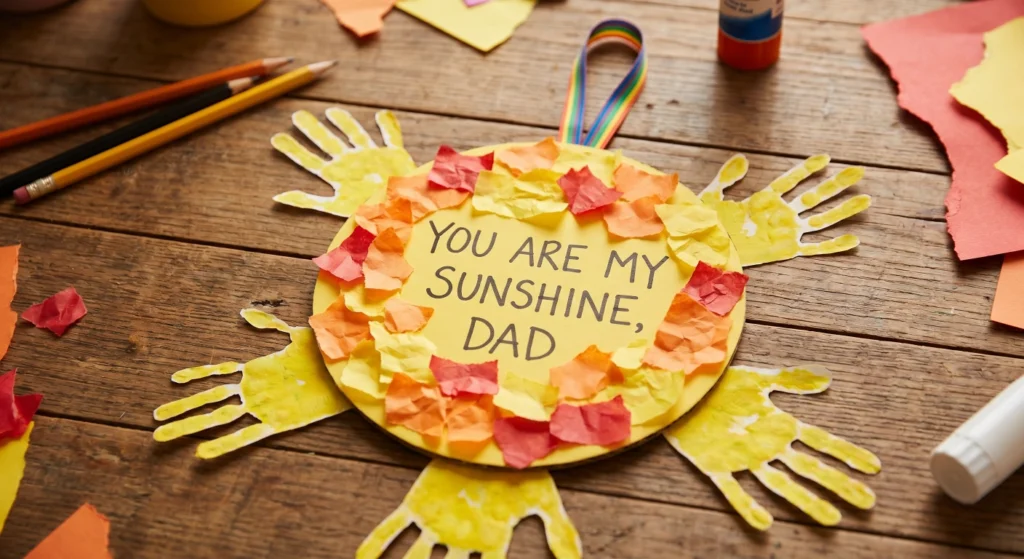
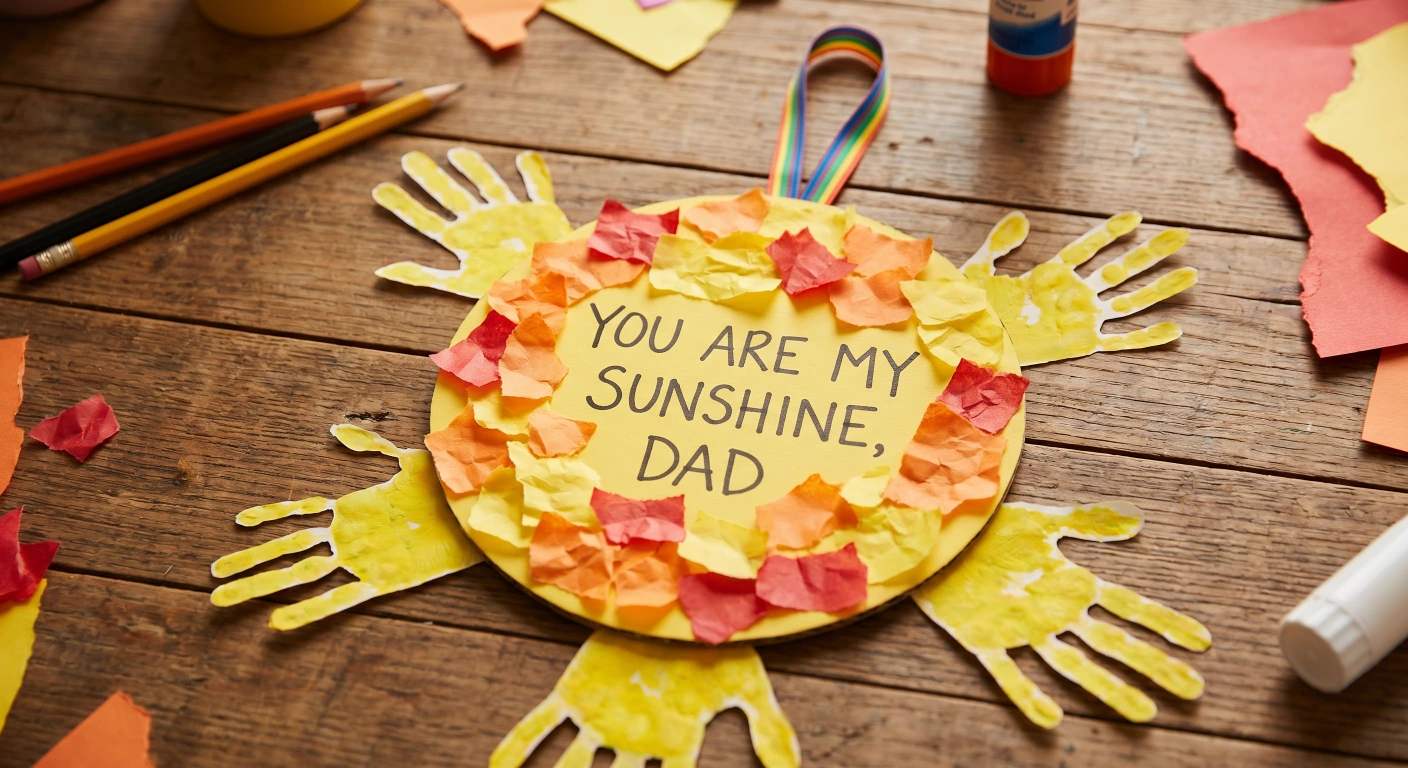
A tissue paper collage sun — a round cardboard circle painted yellow as the sun’s disc, completely covered in small torn pieces of orange, yellow, red, and gold tissue paper that the toddler tears and glues independently using a diluted PVA glue application, the disc surrounded by the toddler’s handprint sunrays in yellow paint pressed around the circle’s perimeter, “You Are My Sunshine, Dad” written across the sun’s center in adult handwriting — is the Father’s Day toddler craft that most joyfully and most texturally celebrates the toddler’s specific developmental achievement of tearing paper independently — a fine motor milestone of the twelve-to-eighteen month developmental period whose successful execution is itself a source of genuine toddler pride and satisfaction that makes the tearing activity intrinsically rewarding rather than merely instrumentally useful. The tissue paper collage sun’s finished texture — the overlapping, slightly translucent layers of torn tissue creating a surface of warmth and depth that painted cardboard cannot match — is genuinely beautiful in a way that far exceeds the simplicity of the craft’s construction technique.
Cut the cardboard sun disc in advance — using a large round plate or bowl as the template for a circle of approximately thirty centimetres in diameter, cut from the kind of corrugated cardboard that is stiff enough to hold its shape during the PVA glue application without warping or buckling under the moisture of the glue. Mix the PVA glue with water in a ratio of two parts glue to one part water — the diluted consistency spreading easily with the foam brush applicator that the toddler uses to apply the glue to the cardboard surface, and drying clear and flat without the surface cracking that full-strength PVA produces when applied in the thick layers that a toddler’s enthusiastic glue application tends to create. Pre-tear some tissue paper pieces in the preparation phase — providing a mixture of pre-torn pieces and large intact sheets from which the toddler can tear their own pieces, so that the activity begins with immediate visible progress from the pre-torn pile rather than the potentially frustrating delay of the toddler’s initial unsuccessful tearing attempts before the technique has been practised and briefly mastered. Allow the tissue paper collage to dry completely and flatly under a weighted board before applying the handprint rays — the warped, bubble-surfaced collage that has dried without weighting creating an uneven surface that prevents the clean, flat handprint contact that well-defined sunray prints require.
15. Yarn-Wrapped Letter “D-A-D”
Yarn-wrapped cardboard letters spelling D-A-D — large cardboard letters cut from thick corrugated cardboard or purchased as pre-cut foam letters, wrapped by the toddler in colorful yarn that is secured at the starting point with a knot and wound around and around the letter form’s body by the toddler’s own hands, then embellished with small pom-poms, foam stickers, and adhesive rhinestones — is the Father’s Day toddler craft that most effectively and most appropriately engages the toddler’s developing fine motor skill of winding, wrapping, and controlling a length of flexible material around a three-dimensional form, a motor challenge whose satisfying tactile quality — the soft yarn sliding through the toddler’s fingers, the gradual coverage of the cardboard surface as wrapping progresses — makes this craft one of the most genuinely engaging and most independently sustainable toddler craft activities available within the Father’s Day craft repertoire. The finished D-A-D display is a home decoration piece of genuine visual warmth whose spelling communicates its identity and its affectionate purpose to every visitor who sees it displayed.
Cut the cardboard letters at a size that makes the wrapping activity genuinely achievable for the toddler’s current fine motor development — a letter height of approximately fifteen centimetres providing the optimal balance between a sufficiently large target for the toddler’s imprecise wrapping movements and a sufficiently small form that complete coverage within a single craft session remains achievable before the toddler’s attention is exhausted. Secure the yarn’s starting end with a piece of tape rather than asking the toddler to maintain the starting knot position while beginning the wrapping — the tape securing the yarn end firmly enough that the toddler can begin wrapping immediately without the first wrap slipping loose before subsequent wraps have established the tension that holds the starting position in place. Choose a yarn weight that is appropriately sized for the letter’s form and the toddler’s hand strength — a chunky or bulky weight yarn covering the cardboard surface quickly enough for the toddler to experience visible progress within the first minutes of wrapping, and thick enough that the toddler’s winding force can be applied with the hand grip rather than the finger pinch that fine yarn requires and that is beyond the fine motor capability of most toddlers under three years old.
16. Paint Chip Bookmark Caterpillar
A paint chip caterpillar bookmark — free paint sample chips collected from a hardware store in graduating shades of one color, cut into circles by an adult and overlapped and glued into a caterpillar body by the toddler using a glue stick, the first circle decorated with the toddler’s fingerprint spots and adult-drawn facial features to create the caterpillar’s head, the completed caterpillar glued to a wide craft stick and labeled “Read with Me, Dad” — is the Father’s Day toddler craft that most cleverly and most economically transforms completely free materials into a finished craft of genuine visual appeal and genuine practical function, creating a reading-themed bookmark whose clever caterpillar design and toddler-made construction make it the most endearing and most conversation-generating bookmark that the father is likely to encounter in any context during the entire span of his reading life. The paint chip caterpillar is the craft that demonstrates creative thinking — the recognition that free materials from a hardware store can become a genuinely beautiful and genuinely personal Father’s Day gift with minimal additional investment.
Select paint chip samples in a single graduating color family — all the greens from pale sage to deep forest green, or all the blues from pale sky to deep navy — for the most visually cohesive caterpillar body color story that the graduated tones create as a linear progression from the caterpillar’s head to its tail end. Cut each paint chip into a circle using scissors and a circular template of consistent diameter — a bottle cap, a large coin, or a compass-drawn circle providing the consistent circle size that makes the caterpillar body’s uniform overlapping rhythm most visually clean and most finished-looking in the completed craft. Overlap the circles by approximately one-third of their diameter when gluing them into the caterpillar body sequence — the one-third overlap creating the most convincing caterpillar body segment appearance, as too little overlap makes the body look like a string of separate circles rather than the overlapping segment progression of an actual caterpillar, while too much overlap makes the color graduation of successive circles too subtle to read clearly as a sequence.
17. Sensory Bottle “Dad’s Calm Down Jar”
A sensory bottle — a clear plastic bottle with a tightly sealed lid permanently secured with strong adhesive, filled with water, clear hair gel or glycerin for viscosity, fine glitter in the father’s favorite colors, tiny star-shaped sequins, small plastic charms, and a drop of food coloring, labeled with a sticker decorated by the toddler reading “Dad’s Calm Down Jar — Shake When Stressed and Watch the Glitter Swirl!” — is the Father’s Day toddler craft that most unexpectedly and most humorously acknowledges the genuine reality of adult work stress with the toddler’s characteristic and entirely genuine solution of the sensory bottle whose glitter-swirling, calming visual effect has been established in early childhood education contexts as a genuine tool for emotional regulation at every age, not only for toddlers. The “calm down jar” label’s humor — the toddler offering their own most powerful stress management tool to the adult in their life who appears stressed — creates the specific quality of toddler gift-giving whose innocent practical generosity is simultaneously funny and genuinely touching.
Fill the bottle with the specific combination of water and glycerin in the proportions that create the most beautiful and most slowly-settling glitter effect — a ratio of approximately seventy percent warm water to thirty percent clear glycerin creating the viscosity that slows the glitter’s settling time from the few seconds of a pure-water bottle to the thirty to sixty seconds of the glycerin-enriched bottle whose prolonged glitter suspension provides the most effective and most mesmerising visual experience during the calming observation that the jar’s intended use requires. Seal the bottle lid permanently with a combination of strong super glue applied to the interior threads and a wrap of self-fusing silicone tape applied to the exterior lid-bottle junction — the dual sealing system preventing the catastrophic lid-off bottle-drop failure that an inadequately sealed sensory bottle produces when the father shakes it enthusiastically and the lid’s inadequately sealed threads give way under the centrifugal force of the shaking action. Decorate the bottle with the toddler’s chosen stickers applied around the bottle’s body before filling — applying the stickers to a dry, clean bottle and sealing over them with a clear contact paper wrap that prevents the stickers from peeling away during the bottle’s regular handling and prevents the water inside from seeping through any microcrack in the bottle’s wall and affecting the stickers’ adhesion over time.