16 4th of July Game Ideas for Kids & Adults
1. Patriotic Cornhole Tournament
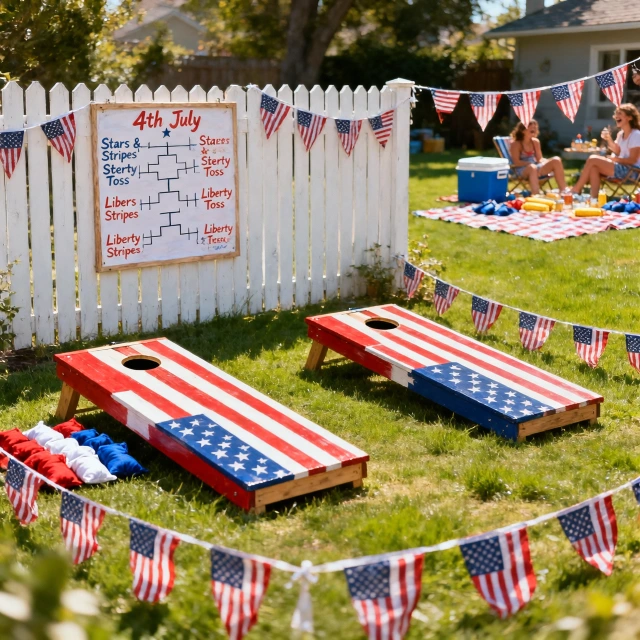
A patriotic cornhole tournament organized with a proper bracket system — boards painted in the American flag design with the stars field in the upper left corner and bold red and white stripes across the playing surface, matched with sets of four red and four blue bean bags per team — is the 4th of July party game that most successfully combines genuine competitive engagement with festive patriotic decoration to create a game experience that draws guests of every age and skill level into enthusiastic, sustained participation throughout the entire afternoon of the celebration. Cornhole occupies a unique position in the American outdoor party game canon — its rules are simple enough to explain in sixty seconds to a first-time player, its skill ceiling is high enough to reward practiced players with genuine competitive satisfaction, and its social format of two-player teams competing side by side creates the exact degree of friendly rivalry and communal energy that makes a backyard party feel genuinely alive and collectively engaged rather than a collection of individual guests sharing a space.
Paint the cornhole boards in the weeks before the celebration using exterior-grade porch paint applied over a properly prepared and primed plywood surface — beginning with the stars field in navy blue in the upper left quadrant, adding white hand-painted stars in the classic fifty-star arrangement, and painting the alternating red and white stripes across the remainder of the board surface using a straight edge for clean, parallel stripe lines. Apply two to three coats of clear exterior varnish over the finished painted surface for durability through years of enthusiastic outdoor use and the inevitable scuffs and scrapes of competitive bean bag play. Create the tournament bracket on a large chalkboard or whiteboard mounted to a fence — listing all participating teams and advancing winners through the bracket rounds with genuine ceremonial seriousness that communicates to guests that their competitive investment is recognized and respected. Award the winning team with a patriotic trophy — a painted wood plaque, a custom medal, or a ribbon in red, white, and blue — presented with enough theatrical ceremony to make the victory feel genuinely earned and genuinely celebrated by the entire assembled gathering.
2. Water Balloon Toss
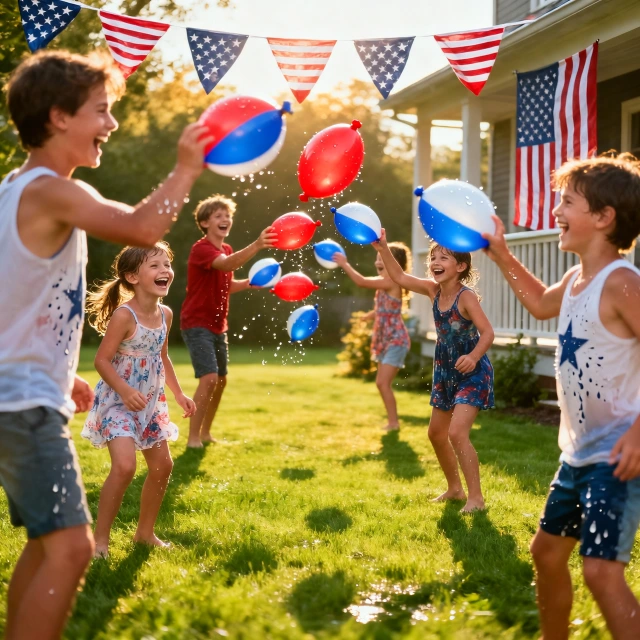
A water balloon toss — pairs of players facing each other across an initial distance of approximately two meters, tossing a single water balloon back and forth, stepping one pace further apart after each successful catch until only one pair remains with an intact balloon — is the 4th of July party game that most immediately, most viscerally, and most joyfully delivers the specific physical pleasure of summer outdoor play that combines the athletic tension of a genuinely skilled catching challenge with the hilariously inevitable reward of warm water exploding over participants when the balloon finally and spectacularly fails to survive contact with the ground or an unsuccessful catch. The water balloon toss generates more genuine, involuntary laughter from a crowd of spectators than almost any other outdoor party game — each unsuccessful catch producing a burst of cold water that is simultaneously unexpected, physically refreshing in summer heat, and visually spectacular enough to produce the communal delight of shared witnessing that makes crowd-spectated games so socially rich and so atmospherically valuable for a backyard party.
Fill the water balloons the morning of the party — a task most efficiently accomplished using a multi-nozzle balloon filling attachment that connects to a standard garden hose and fills multiple balloons simultaneously, reducing the preparation time from several hours to approximately thirty minutes for several hundred balloons. Fill each balloon to a size that provides sufficient water for a satisfying burst on impact while remaining small enough to be catchable with cupped hands — approximately the size of a large orange is the ideal preparation target. Sort the filled balloons by patriotic color — red, white, and blue — and distribute one matching color pair to each competing team for the festive visual element that connects the game to the celebration’s patriotic identity. Award winning pairs with a patriotic ribbon, a small prize from a prize bucket, or simply the communal recognition of the assembled spectators whose genuine appreciation of a skillfully maintained water balloon partnership across twenty meters of separation is itself the most satisfying form of competitive validation the game can offer.
3. Patriotic Scavenger Hunt
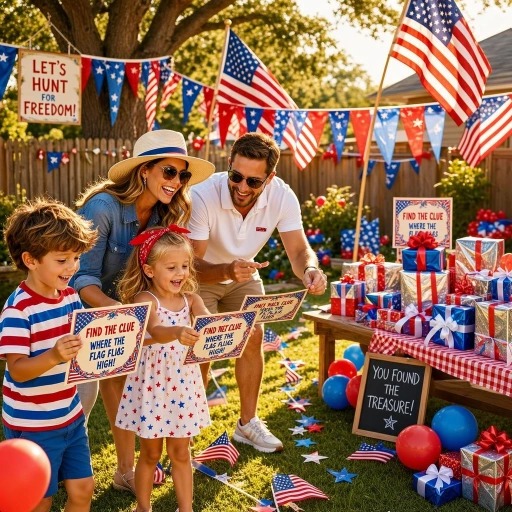
A patriotic scavenger hunt — clue cards designed with American flag borders and red, white, and blue color schemes leading participants through a sequence of hidden locations around the backyard, each clue referencing American history, 4th of July traditions, or patriotic symbols in the form of riddles that require genuine thought and genuine exploration to solve — is the 4th of July party game that most completely engages participants’ minds as well as their physical energy, creating a game experience that is simultaneously educational, physically active, socially collaborative, and genuinely suspenseful in its building anticipation of each successive clue discovery and the final prize reveal at the hunt’s end. The scavenger hunt’s particular strength as a party game is its capacity to scale across a wide age range — with clue difficulty calibrated appropriately for the competing age groups and the option of mixed-age teams that pair adults with children for a genuinely inter-generational collaborative experience that strengthens relationships across generational divides within a family or friend group.
Write the clues with the specific combination of thematic relevance and genuine solvability that makes scavenger hunt riddles genuinely satisfying rather than frustratingly opaque or boringly obvious — referencing familiar 4th of July and American cultural landmarks within the backyard setting through wordplay, riddles, and visual descriptions that lead solvers to specific locations with sufficient clarity for eventual success but sufficient ambiguity for genuine challenge. Hide the clues at locations that distribute the hunt broadly across the available outdoor space — under the picnic table, inside the cooler, attached to a specific lawn game, pinned to a flagpole, tucked inside a potted patriotic flower arrangement — for a hunt that physically explores the entire celebration space and gives participants a genuinely adventurous sense of covering ground and making discoveries. Create a separate simplified hunt for the youngest children using picture clues rather than written riddles, allowing them to participate authentically in the game experience at an age-appropriate level of cognitive engagement. Award all participants with a patriotic prize upon completing the hunt — regardless of finishing order — to ensure that the game’s primary reward is the experience of participation rather than the competitive result of placing first.
4. Giant Jenga with Patriotic Challenges
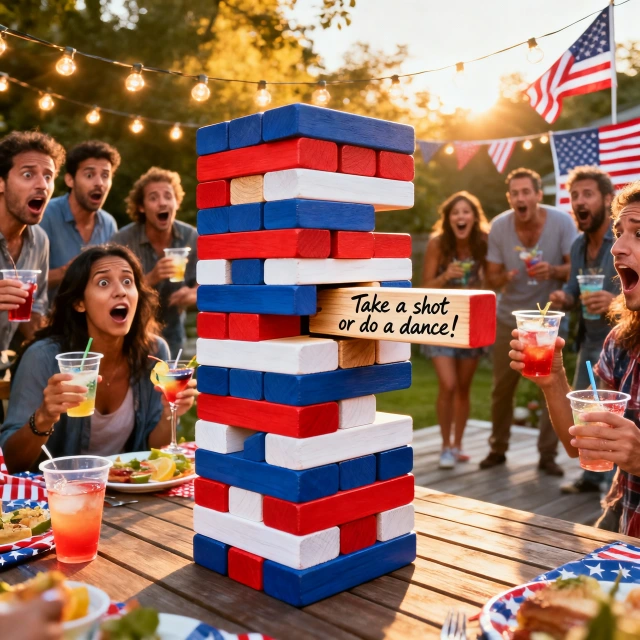
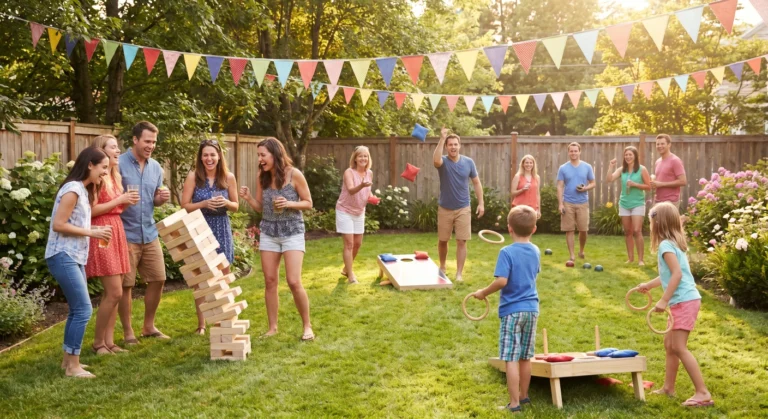
Giant Jenga with patriotic challenges written on selected blocks — approximately one-third of the blocks carrying a written dare, patriotic trivia question, or group activity instruction on their pulled face, with the remaining blocks blank for standard play — is the 4th of July party game that most reliably generates the most consistently sustained group engagement, the most genuine suspense, and the most reliably laughter-generating social interactions of any game in the backyard celebration’s complete game program. The challenge blocks transform standard Jenga from a purely individual skill-based game into a social performance game whose unpredictability — any pull could reveal either a blank block for quiet strategic relief or a challenge block demanding immediate public action — creates the specific combination of tension, anticipation, and communal witnessing that makes the game irresistible to gather around and impossible to walk away from mid-game.
Write the challenge blocks with a carefully calibrated variety of challenge types that serve different social functions within the gathered group — silly physical challenges like “do your best impression of fireworks exploding” or “hold your arms above your head until someone else pulls a block” that produce immediate physical comedy and group laughter, patriotic trivia questions like “name the year the Declaration of Independence was signed” or “which president was born on the 4th of July” that produce educational engagement alongside competitive pressure, and social challenges like “tell the group your favorite 4th of July memory” or “teach the group your best dance move” that generate genuine personal sharing and memorable social moments beyond the competitive game frame. Paint the blocks before the party in alternating red, white, and blue — using exterior-grade paint for durability through years of outdoor use and the inevitable rough handling of an enthusiastically played game — for the patriotic visual identity that connects the game to the celebration’s overall aesthetic program. The colored blocks create an additional visual element as the tower’s color distribution becomes increasingly random and visually complex through the game’s progressive deconstruction.
5. Sack Race with Patriotic Burlap Sacks
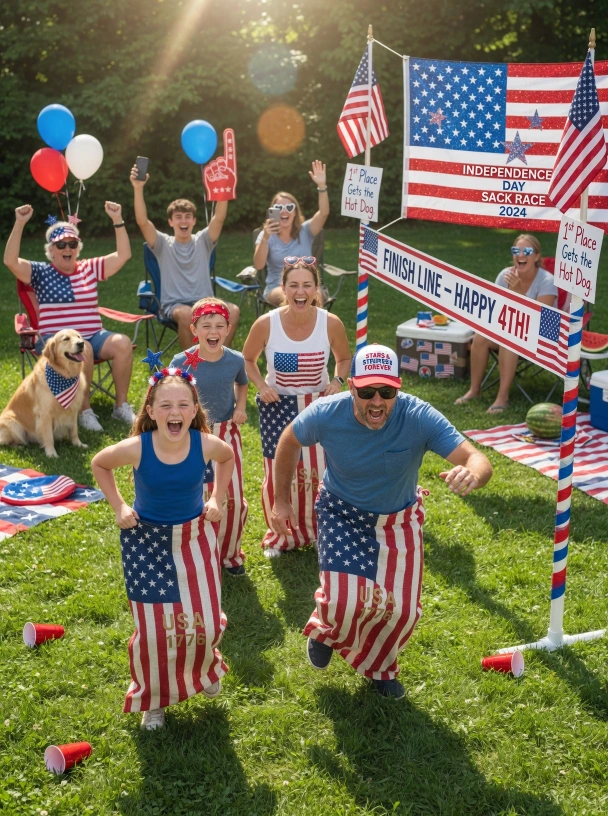
A sack race using burlap sacks hand-painted or dyed in red, white, and blue stripes — competitors standing inside the sacks, holding the top edge at waist height, and hopping as rapidly as possible toward a finish line strung with American flag bunting — is the 4th of July party game that most directly and most joyfully connects the celebration to the great American tradition of outdoor field games at summer community events, county fairs, and school picnics that have provided exactly this specific form of enthusiastic, undignified, genuinely hilarious competitive fun for generations of American summer celebrations. The sack race has the rare quality of being a game whose humor and joy are entirely accessible and entirely shared regardless of the participant’s athletic ability — the burlap sack’s constraint makes skilled athletes as ungainly and as comically unstable as complete beginners, creating the genuinely democratic playing field where a grandmother can legitimately defeat a twenty-year-old former track athlete to the universal delight of all assembled spectators.
Source genuine burlap sacks from a agricultural supply company, a coffee roaster, or a craft supplier — the coarser, more substantial burlap of a genuine utility sack provides better grip and more structural stability than the loosely woven fabric of cheaply produced craft versions that tend to tear under the physical stress of competitive hopping. Paint or dye the sacks in patriotic colors the week before the party — using fabric paint applied with a wide brush in broad diagonal stripes for the most visually impactful patriotic identification, or using cold water fabric dye for a deeper, more thoroughly integrated color if a more refined appearance is preferred. Create separate race heats organized by age group — children under ten, teenagers, adults under fifty, and adults over fifty — so that each heat presents a genuinely competitive field of participants with comparable physical capabilities, allowing genuine competitive suspense rather than predictable outcomes that remove the competitive tension that makes the race exciting to participate in and exciting to watch. Award winners with patriotic medals made from red, white, and blue ribbon and a gold cardboard medallion stamped with a star and “4th of July Champion” for the specific ceremonial recognition that transforms a backyard game result into a genuinely treasured competitive memory.
6. Patriotic Ring Toss
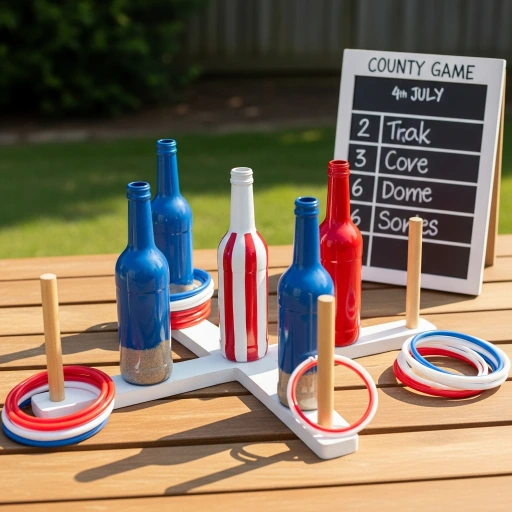
A patriotic ring toss game assembled from glass bottles spray-painted in alternating red, white, and blue and filled with sand for stability, arranged in a triangle formation on a low wooden table, with a set of rope or plastic rings in matching patriotic colors stacked beside the bottles and a distance line marked with a length of red, white, and blue ribbon on the ground approximately two meters away — is the 4th of July party game that most evocatively captures the specific aesthetic of the American county fair and summer carnival midway within a backyard setting, delivering the specific nostalgic pleasure of a familiar, simple skill game whose difficulty is perfectly calibrated to be genuinely challenging without being frustrating for players of any age. The ring toss’s county fair heritage gives it a specific cultural warmth and summer celebration association that more contemporary game formats lack — it connects the 4th of July gathering to a longer tradition of American summer festivity that extends back through generations of outdoor community celebrations.
Fill the painted bottles with approximately eight centimeters of dry sand — sufficient to prevent the bottles from tipping when a ring lands on the neck but not so much that the bottles become immovably heavy and therefore impractical to transport, reset, and rearrange as the game progresses through multiple rounds of play. Arrange the bottles in a regulation triangular bowling-pin formation — one bottle in the front row, two in the second, and three in the third — with approximately fifteen centimeters of space between each bottle to allow rings to fall cleanly between the bottles when not landing on a neck rather than bridging between bottles and creating disputed scoring situations. Assign point values to different bottles — the back-row bottles furthest from the throwing line worth more points than the front-row bottle closest to the line — and mark the point values directly on each bottle using a paint pen for immediate visual clarity during competitive play. Run the game as a continuous open station where individual players attempt three rings per turn and record their scores on a running leaderboard, with a prize bucket awarding small patriotic prizes — star-shaped sunglasses, patriotic candy, mini flags — for scores above specific threshold levels rather than only for the single highest score of the day.
7. Three-Legged Race
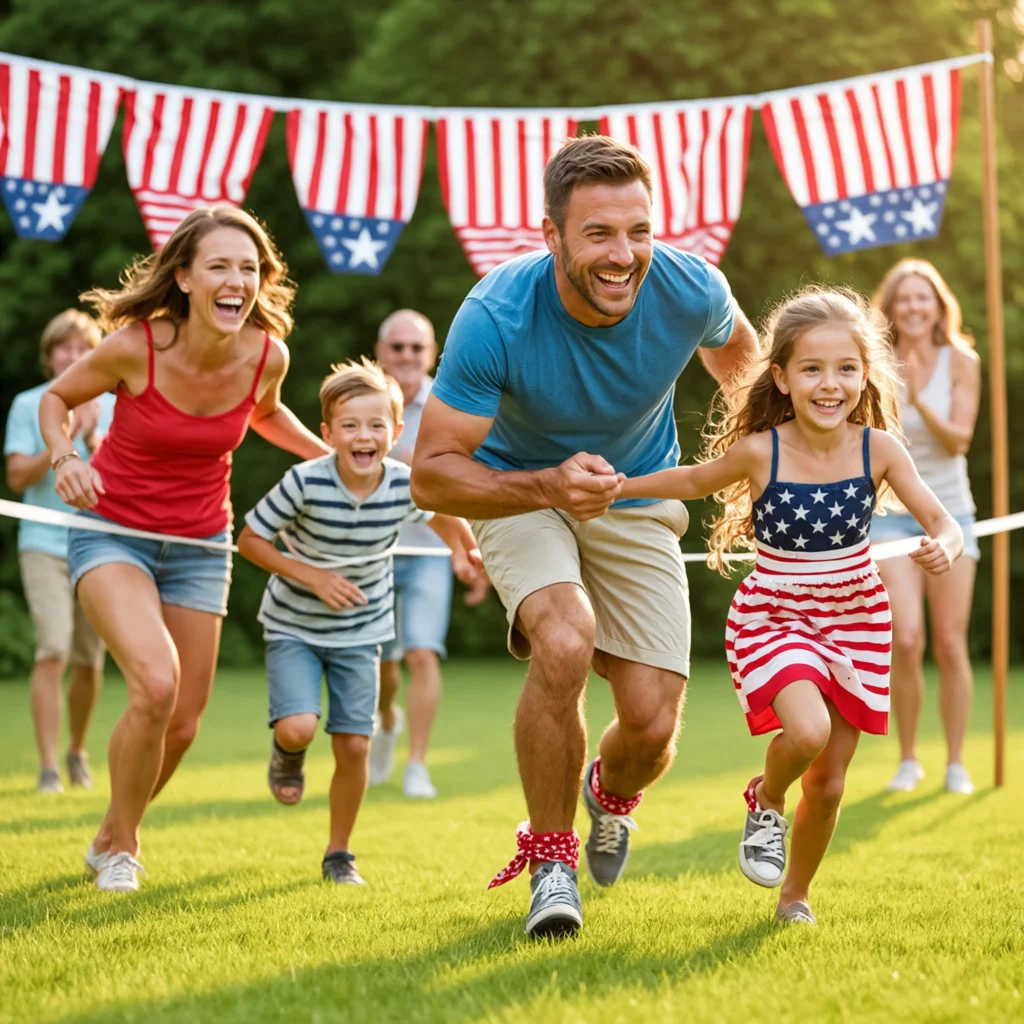
A three-legged race where pairs of players stand side by side, their adjacent ankles bound together with a red and white bandana, and race toward a finish line strung with American flag bunting — is the 4th of July party game that most reliably produces the most genuine, most uninhibited, most physically expressive laughter from both participants and spectators, because the three-legged race’s particular combination of intimate physical coordination requirement, unpredictable stumbling dynamics, and the absolute certainty that even the most athletically gifted pair will eventually fall in a magnificently undignified heap produces a quality of honest, embodied hilarity that no other game quite replicates. The three-legged race is the 4th of July party game that requires the most trust between partners — the complete surrender of individual locomotion autonomy to a shared, negotiated movement system — making it uniquely valuable as a game that builds genuine relational connection alongside physical comedy.
Organize the race in mixed-age pairs deliberately rather than allowing self-selection — pairing a grandparent with a grandchild, an uncle with a teenage niece, or a new acquaintance with a long-established friend creates pairings whose inter-generational or interpersonal unfamiliarity generates additional comedy and connection-building value beyond what self-selected pairs of similar age and familiarity would produce. Brief all pairs on the fundamental three-legged race technique before the starting signal — the outside leg of each partner steps first simultaneously, then the inside bound legs step together in a single unified movement, establishing the basic alternating rhythm that most pairs will immediately abandon under the competitive pressure of the starting gun in favor of a lurching, improvised, increasingly desperate movement strategy that is considerably more entertaining for spectators. Use genuinely soft, fabric bandanas for the ankle binding rather than rope or cord that can cause discomfort or restrict circulation during the race — the bandana’s width distributes the binding pressure comfortably across the ankle and lower leg while its fabric texture prevents slipping without requiring tight binding that could cause harm. Award all participating pairs with a patriotic participation ribbon regardless of finishing order, reserving a specific winner’s prize for the first-place pair’s genuinely athletic achievement.
8. Patriotic Trivia Contest
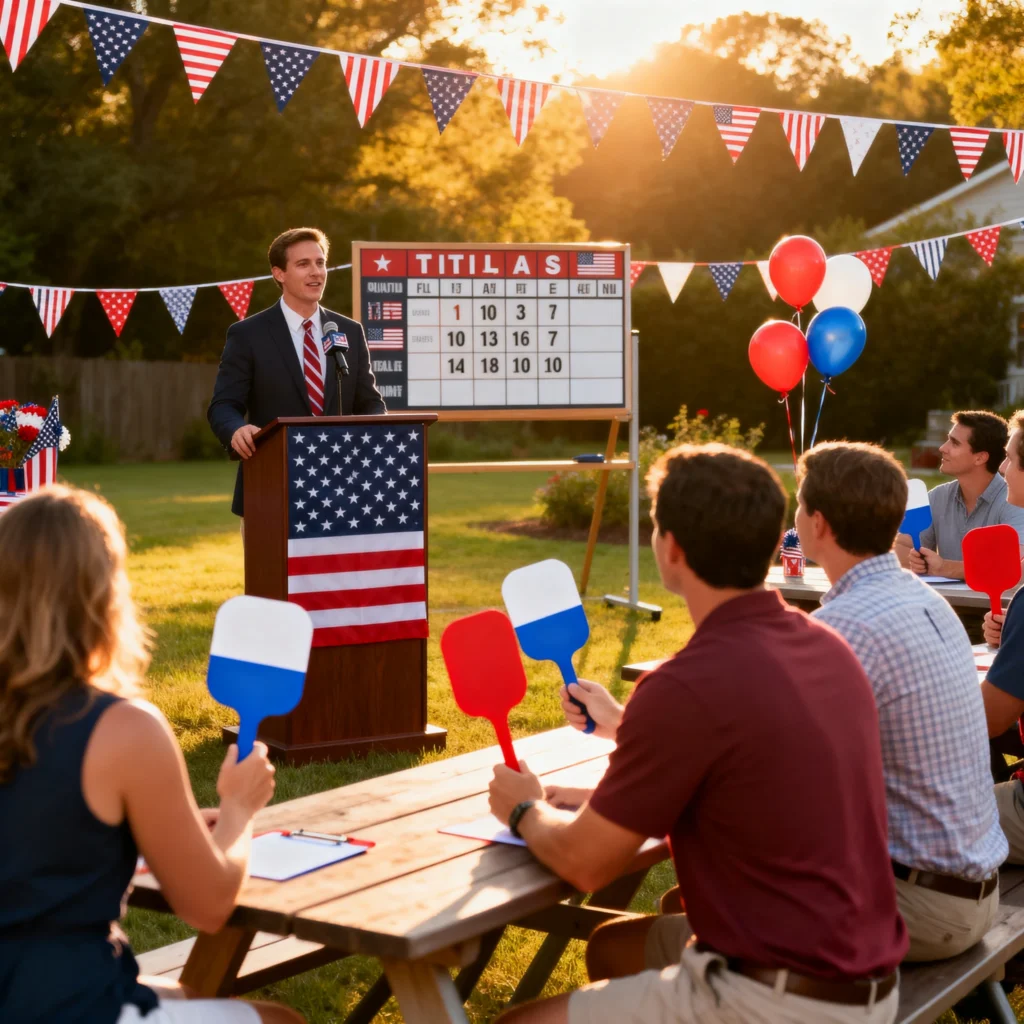
A patriotic trivia contest organized in team rounds — teams of four to six players seated at labeled picnic tables, competing across five categories of American history and 4th of July knowledge including Founding Fathers, American symbols, Independence Day traditions, US geography, and pop culture patriotism — is the 4th of July party game that most intellectually engages guests, most effectively crosses age and generation lines through the natural complementarity of different generational knowledge bases within mixed-age teams, and most genuinely celebrates the specific historical and cultural content of the Independence Day holiday by making knowledge of American history and tradition the direct currency of competitive success and collective celebration. The trivia contest is the party game that produces the most authentic inter-generational collaboration — the child who knows every state capital, the parent who knows Civil War history, and the grandparent who remembers mid-century Americana all contribute genuinely different and genuinely complementary knowledge to the team’s collective competitive capability.
Write questions across five genuine difficulty levels within each category — ensuring that the easiest questions in each category are accessible to the youngest participating children while the hardest questions challenge the most historically knowledgeable adults without either demographic group experiencing either consistent confusion or consistent boredom across the full round of play. Include a mix of straight factual recall questions, visual identification rounds where teams identify patriotic symbols and American landmarks from photographs, audio rounds where teams identify patriotic songs from brief instrumental clips, and collaborative puzzle rounds where teams must arrange historical events in chronological sequence or complete partial famous American quotations. Create answer paddles from painted cardboard mounted on wooden dowels — each team receiving a set of numbered paddles they hold up simultaneously at the host’s signal rather than shouting answers aloud, preventing the faster teams from intimidating the slower ones with immediate vocal answers that remove the tension of collective uncertainty from the room before every team has had the opportunity to fully consider the question. Award the winning team with a genuine trophy — a patriotic plaque, a custom certificate, or a prize basket filled with patriotic items and celebration treats — presented with the theatrical ceremony appropriate for a legitimately hard-won intellectual competitive victory.
9. Slip-and-Slide Obstacle Course
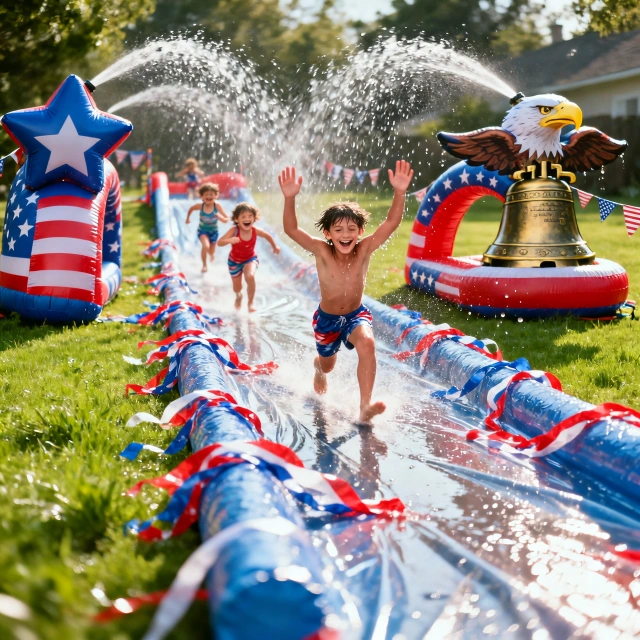
A slip-and-slide obstacle course — a long commercial-grade plastic slide augmented with sprinkler arches that spray water over the slide surface, patriotic inflatable obstacles positioned at the course edges, a pool of water balloons at the finish end requiring participants to pop a balloon before their run is complete, and a timer board that records each participant’s course completion time — is the 4th of July party game that most dramatically, most physically, and most joyfully satisfies the specific summer heat relief need that a July outdoor gathering in most American climates creates for every participant regardless of age. The slip-and-slide obstacle course solves the practical problem of keeping guests cool during a summer afternoon celebration while simultaneously creating the party’s most spectacular, most photographed, and most enthusiastically discussed game activity — the specific combination of speed, cold water, and physical abandon that a slip-and-slide course delivers is uniquely, completely, and reliably joyful in a way that almost no other party game can match.
Prepare the slide surface by running a garden hose with a spray nozzle attachment along its full length for at least five minutes before the first participant slides — ensuring the plastic surface is thoroughly saturated with a continuous water film that provides genuine low-friction slip rather than the skin-dragging friction of a partially wet plastic surface that produces the specific unpleasant friction burn that turns a potential joy into a physical deterrent. Add a small amount of liquid dish soap to the water supply for the first hour of use — the soap dramatically reduces friction and increases sliding speed to the levels that create the most spectacular, most photographically impressive slides. Position a reliable adult supervisor at the slide’s starting end to regulate spacing between participants — ensuring each slider has reached the slide’s end and cleared the finish zone before the next participant begins their run, preventing the collisions that transform a safely managed water activity into a potential injury situation. Decorate the slide area comprehensively with patriotic elements — red, white, and blue streamers woven through the inflatable border obstacles, small American flags planted along the lawn beside the slide, and patriotic bunting strung from the yard’s trees overhead to create the festive visual context that connects the physical activity to the celebration’s identity.
10. Egg and Spoon Race
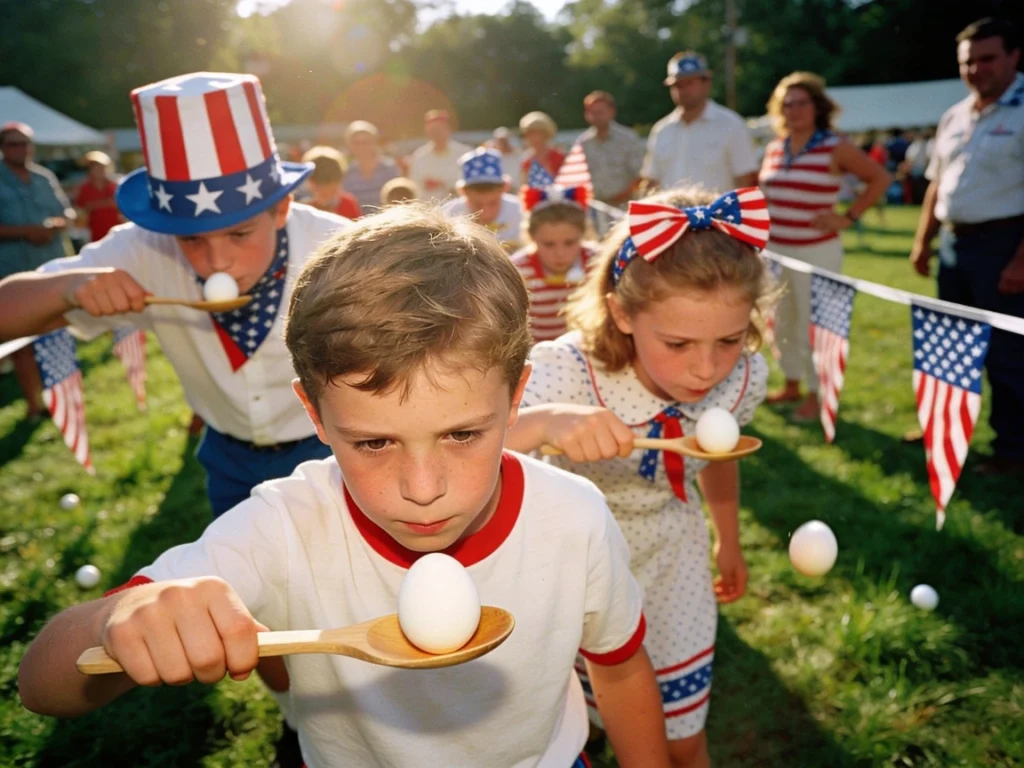
An egg and spoon race — participants balancing a raw egg on a large wooden spoon held at arm’s length, racing to a distant finish line while keeping the egg balanced through the specific combination of steady hand, slow careful movement, and the constant micro-adjustments of a skilled balancer working against the egg’s tendency to roll in the direction of the slightest spoon tilt — is the 4th of July party game that most subtly and most entertainingly rewards patience, steadiness, and the specific quality of careful controlled movement over pure speed, creating a game whose outcome is genuinely unpredictable because the fastest participants inevitably sacrifice the stability that egg retention requires while the most carefully controlled participants inevitably sacrifice the speed that winning requires. The egg and spoon race’s inherent comedy — the moment of horrified expression that precedes the inevitable catastrophic egg drop, the tentative recovery attempted by optimistic participants who believe a fractured egg still counts as technically balanced — is entirely self-generating and entirely dependent on nothing more than the fundamental physics of a round object on a flat surface.
Use hard-boiled eggs rather than raw eggs for a family party — the hard-boiled egg’s interior solidity reduces the rolling sensitivity that makes raw eggs so treacherously difficult to balance, making the race appropriately challenging for mixed-age participants rather than technically impossible for younger children who lack the fine motor steadiness that raw egg balancing genuinely requires. Paint the hard-boiled eggs in red, white, and blue — using food-safe egg dye for a quick and reliably food-safe coloring process — for the patriotic visual identity that connects this classic game to the celebration’s 4th of July theme. Use large wooden cooking spoons as the racing utensil rather than regular tablespoons — the larger bowl of a cooking spoon provides a slightly larger surface area for egg stabilization while its longer handle creates more leverage distance from the hand to the egg that amplifies the destabilizing effect of any hand tremor, maintaining genuine difficulty while keeping the game accessible to younger participants. Create separate heats for children and adults with age-appropriate finish line distances — ten meters for children under eight, fifteen meters for older children and teenagers, and twenty meters for competing adults — maintaining genuine challenge across all age groups.
11. Patriotic Duck Duck Goose
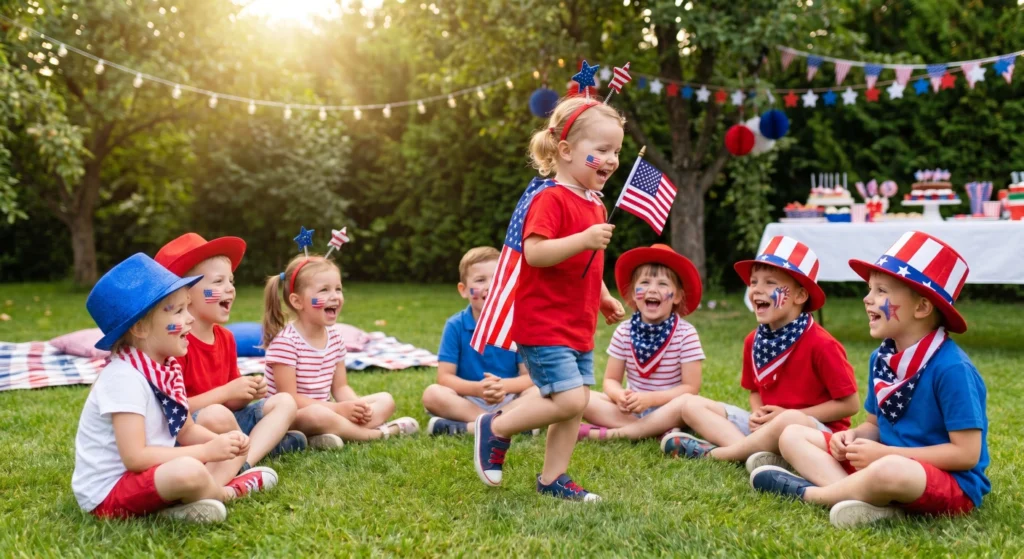
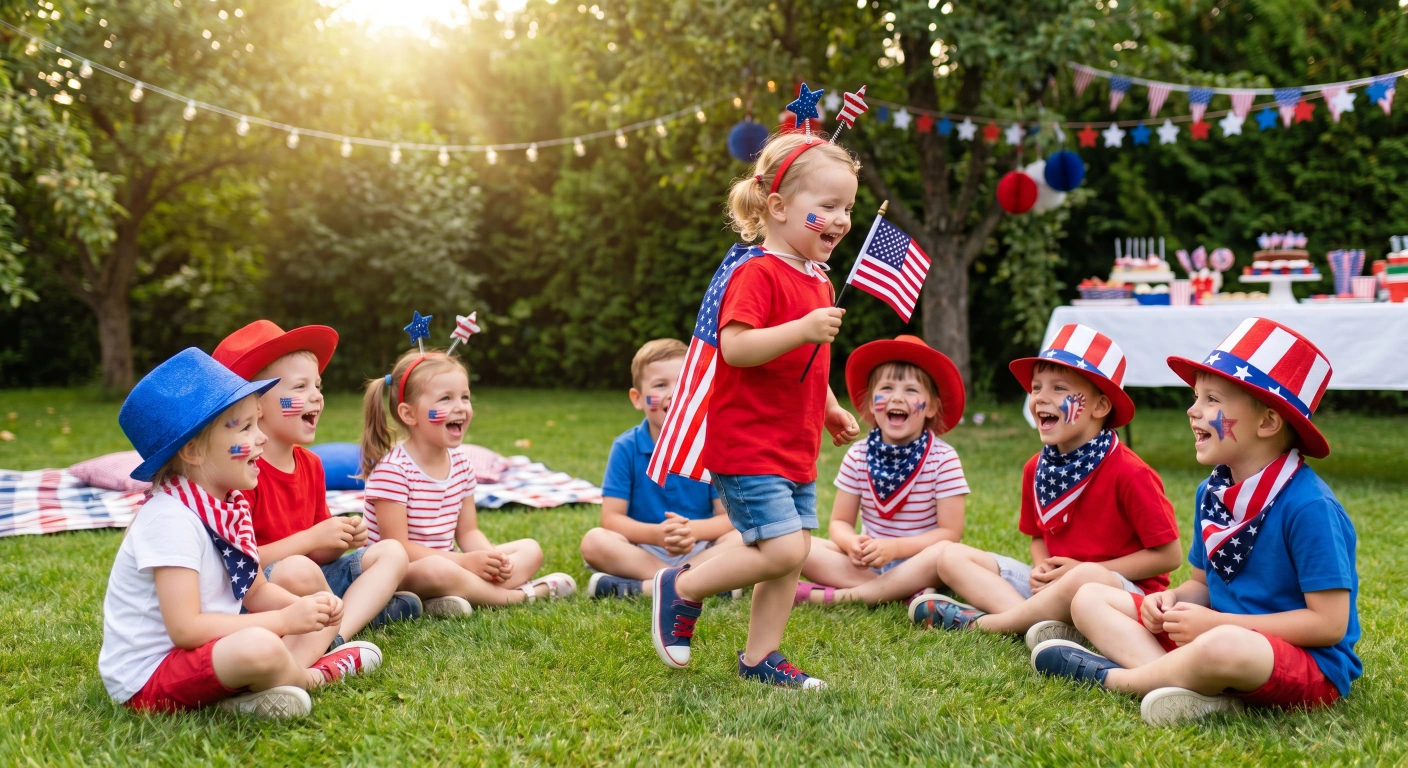
Patriotic duck duck goose — the classic children’s circle game played with a patriotic theme, with the walking player carrying a small American flag while tapping seated players’ heads and calling “red, white, white, white, BLUE!” instead of the traditional duck duck goose pattern — is the 4th of July party game that most warmly, most inclusively, and most appropriately entertains the youngest guests at the celebration while creating a dedicated children’s game activity zone that allows the adults to enjoy their own games nearby while the children have their own age-appropriate, independently managed game experience with genuine excitement and genuine physical engagement. The circle game format’s specific structural simplicity — no equipment beyond a single small flag, no preparation beyond gathering children in a circle, and rules explainable to a four-year-old in thirty seconds — makes it the most immediately deployable and most reliably successful game for the under-eight age group at any party gathering.
Set up the patriotic duck duck goose area on a specific section of the lawn designated as the children’s game zone — marked with patriotic bunting on small stakes at the zone corners for visual definition and separated from the adult game area by sufficient distance to prevent interference between the two game programs. Dress all participating children in patriotic accessories before the game begins — handing each child a star-shaped headband, a small American flag to wear tucked into their waistband, and a sticker in red, white, or blue applied to their hand for the visual patriotic identification that transforms the standard game into a specifically 4th of July celebration activity. Appoint an enthusiastic adult or older teenager as the game facilitator — managing the rotation of the “it” role, enforcing the simplified rules with generous patience for the youngest participants’ inevitable rule confusion, maintaining the game’s energy through animated facilitation, and ensuring that every child has multiple turns as the “it” player throughout the full game session regardless of their speed advantage or disadvantage in the chasing element of the game that can otherwise permanently assign the “it” role to the fastest children.
12. Firework Drawing Contest
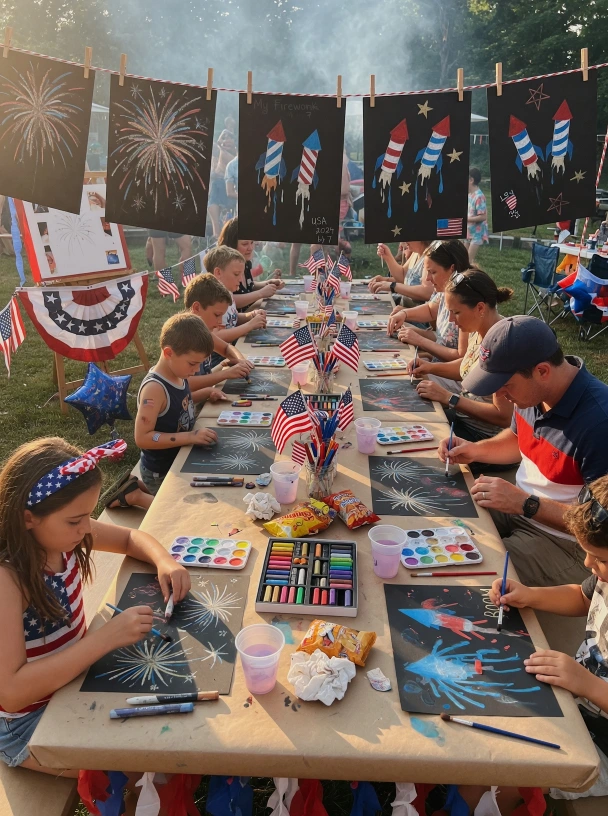
A firework drawing contest — participants of all ages seated at outdoor tables covered in kraft paper, given sheets of black or dark navy paper and a selection of chalk pastels, metallic watercolor paints, and fluorescent markers, challenged to create the most spectacular, most colorful, and most imaginatively detailed fireworks display drawing within a fifteen-minute time limit — is the 4th of July party game that most creatively engages participants’ artistic expression, most beautifully produces tangible, displayable results that contribute directly to the party’s decorative program, and most genuinely includes guests of every age and every competitive temperament by centering the activity on personal creative expression rather than physical performance or factual knowledge where ability differences between age groups can feel discouraging rather than exhilarating. The firework drawing contest is the party game for guests who prefer creative engagement to competitive racing — expanding the party’s game program to serve personality types that conventional physical and competitive games consistently under-serve.
Provide the black paper as the drawing surface specifically rather than white paper — white paper severely limits the visual impact of chalk pastel and metallic paint firework drawings by preventing the specific contrast between dark background and bright, colorful mark-making that makes firework artwork genuinely spectacular, while black paper allows chalk pastels and metallic paints to display their full luminous brilliance in the way that mimics the visual experience of actual fireworks against a dark night sky. Set out chalk pastels in a full spectrum of bright and metallic colors — gold, silver, copper, white, and bright primary and secondary colors — alongside metallic watercolors, fluorescent markers, and white gel pens for the most versatile drawing toolkit that allows participants to create a wide range of mark-making techniques from smeared chalk pastel starburst effects to fine gel pen sparkle lines. Display all completed artworks on a string line strung between trees at eye height — using wooden clothespins to hang each piece immediately upon completion rather than waiting for a complete collection before displaying, so that the string line grows progressively more populated and more visually spectacular throughout the contest period, creating a growing gallery that motivates late participants by showing them the visual standard established by earlier competitors.
13. Tug of War with Team Colors
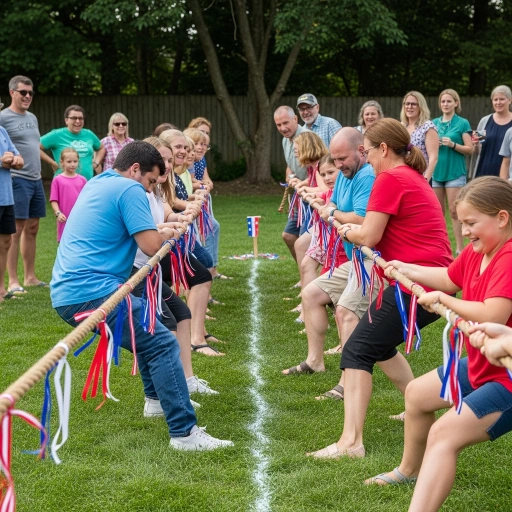
A tug of war game with teams assigned by patriotic color — red team versus blue team, their membership indicated by ribbon wristbands tied at the wrist in the team color before competition begins, competing across a center line marked in the grass with a length of white rope, pulling on a thick cotton rope decorated with red, white, and blue ribbons tied at intervals along its length — is the 4th of July party game that most dramatically and most physically engages the entire assembled gathering in a single unified competitive moment of collective physical effort, communal cheering, and the specific quality of total-body exertion that makes tug of war uniquely satisfying as both a participant and a spectator game. The tug of war generates the most intensely unified crowd energy of any game in the backyard party’s complete game program — the entire gathering divides instantly and enthusiastically into two clearly identified opposing camps whose vocalized, increasingly urgent support for their respective team creates the most genuine, most spontaneous, and most powerfully communal competitive atmosphere of the entire celebration.
Organize teams to ensure genuine competitive balance — deliberately mixing ages, sizes, and physical strengths across both teams rather than allowing natural self-selection that tends to produce one stronger and one weaker team whose predictable outcome removes the genuine competitive tension from the event. Assign team membership by drawing colored wristbands from a bag rather than through self-selection — the random assignment produces teams whose mixed composition of ages, sizes, and strengths is more likely to be genuinely competitive, and the element of random assignment adds its own element of surprise and humor as guests discover which team they will represent. Establish and communicate the rules clearly before competition begins — the winning team is the one that pulls the center ribbon on the rope past a mark on their side of the center line, with the center mark beginning directly over the center line at the start of each round. Run three rounds to determine the overall winning team — best of three rather than a single round extends the competitive engagement and provides the possibility of comeback for a team that loses the first round, maintaining the suspense and collective engagement of spectators whose support remains meaningfully impactful throughout three rounds of genuine effort.
14. Freeze Dance to Patriotic Music
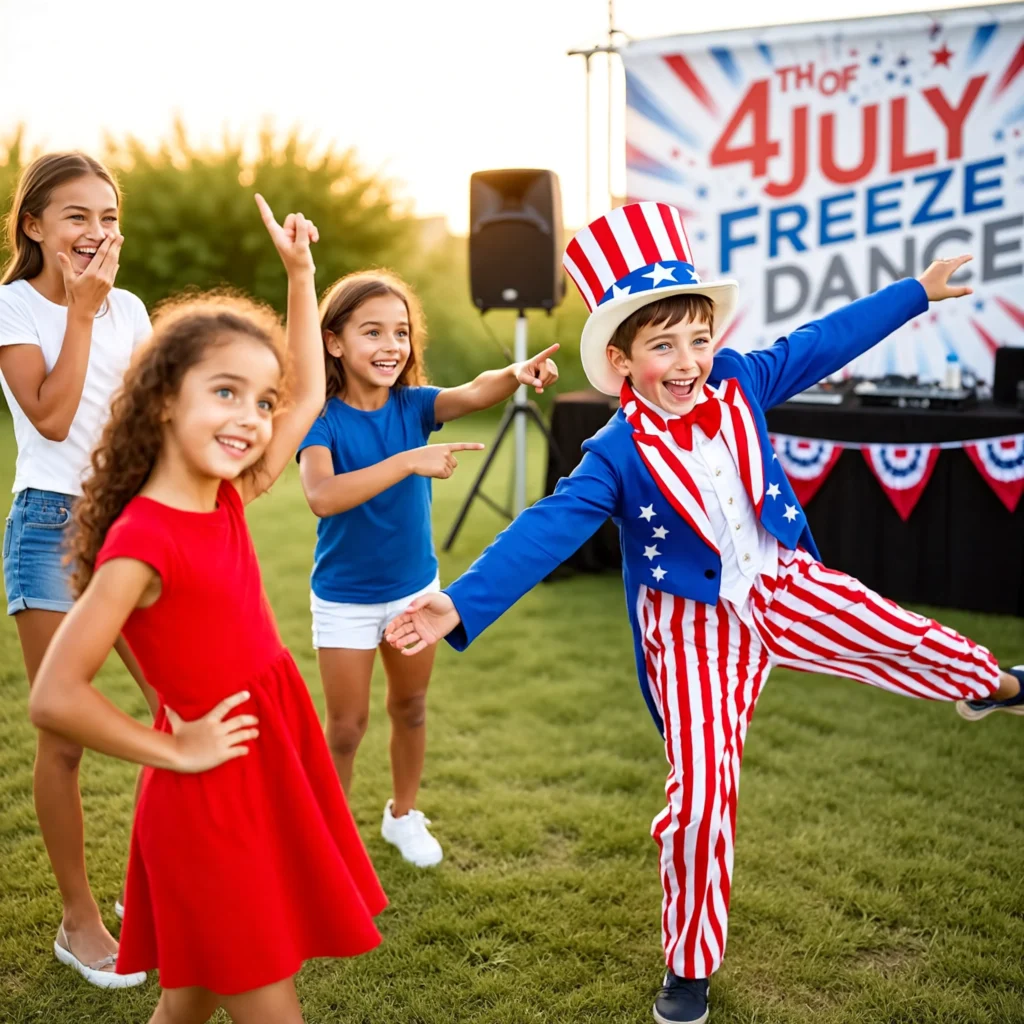
Freeze dance to a patriotic music playlist — participants dancing enthusiastically to a curated selection of American classics including “Stars and Stripes Forever,” “Yankee Doodle,” classic rock anthems, and patriotic pop songs, freezing in their exact dance position the instant the music pauses, with any participant who moves after the freeze signal being lovingly eliminated from the round — is the 4th of July party game that most joyfully and most physically engages the youngest guests while producing the specific visual comedy of frozen mid-dance poses that makes this game genuinely hilarious for spectators regardless of whether they are currently participating in the active round or watching from the sidelines. The freeze dance game’s genius is its perfect calibration of physical activity level and rule simplicity for the three-to-eight-year-old age group — demanding full physical engagement during the music but requiring only a single, binary response rule that even the youngest preschooler can understand and reliably apply.
Curate the patriotic music playlist with genuine thought for the specific range of tempos, styles, and energy levels that will make the dancing portion of each round genuinely fun and genuinely dance-inspiring for the specific age range of participating children — beginning with faster, higher-energy tracks that inspire large, expressive movement, transitioning through mid-tempo pieces where the rhythm is clear and the dance movement naturally more structured, and concluding with occasional slow, stately patriotic marches where even the most enthusiastic small dancer naturally slows to the music’s pace, creating the hilarious visual contrast of solemnly marching children suddenly freezing in dignified military march position. Control the music pause timing from a phone or tablet where the play and pause buttons are easily accessible — varying the pause timing unpredictably from very short musical phrases to extended dance periods of thirty seconds or longer to prevent children from anticipating the freeze signal and gaming the game’s challenge with false freezes timed to their own prediction rather than the music’s actual stopping. Allow eliminated participants to become official “judges” who watch for post-freeze movement among the remaining active dancers, maintaining their engaged involvement in the game’s social experience after their own competitive participation has ended.
15. Horseshoe Tournament
A horseshoe tournament played at regulation distance — stakes driven forty feet apart for adults and twenty-five feet apart for junior competition, with sets of two red and two blue horseshoes per competing player, scored by the official cancellation scoring system where equal points cancel and only the player with the closest horseshoes scores — is the 4th of July party game that most authentically honors the specific American outdoor game heritage of the celebration, connecting the backyard competition directly to the centuries-long tradition of horseshoe pitching at American county fairs, military camps, and community gatherings where this specific game has been played with essentially unchanged rules, equipment, and competitive format since its widespread adoption in the nineteenth century American countryside. Horseshoes is the 4th of July game of genuine skill — its mastery requiring the specific combination of consistent release mechanics, distance calibration, and mental composure under competitive pressure that only deliberate practice over multiple seasons develops to the level of genuine competitive proficiency.
Install the stakes at precisely the regulation distance for the competing age group using a measuring tape rather than estimation — the regulation distance is a genuine game parameter whose precision matters to the competitive experience’s authenticity and whose casual disregard communicates a lack of respect for the game’s heritage that dedicated horseshoe players immediately notice and find disappointing. Drive the stakes into the ground at the regulation forward lean of twelve degrees from vertical — the angled stake’s forward tilt is not merely traditional but genuinely functional, providing a forward-facing ledge for thrown horseshoes to catch on the stake and remain in the ringers position that is the highest-scoring throw in the game. Mark the throwing line — the foul line from behind which all pitches must be made — with a length of white rope or a painted strip on the ground at the regulation distance of thirty-seven feet from the opposite stake for adult play, creating the clear visual boundary that prevents competitive disputes about throwing position. Award the tournament winner with a genuine trophy — a small replica horseshoe on a mounted plaque, a custom ribbon, or a patriotic prize basket — presented at the day’s end with the ceremony appropriate for a legitimately skilled and legitimately hard-earned competitive victory.
16. Minute-to-Win-It Patriotic Challenges
A Minute-to-Win-It patriotic challenge series — five individual timed challenge stations where participants have exactly sixty seconds to complete patriotic-themed physical tasks including stacking star-shaped cookies from forehead to mouth without using hands, sorting a mixed pile of red, white, and blue M&Ms into three separate cups while blindfolded, building the tallest possible tower from mini marshmallows and toothpicks, unwrapping twenty mini patriotic chocolates using only oven mitts, and blowing a cotton ball across a finish line using only breath — is the 4th of July party game program that generates the most sustained, most varied, and most universally accessible competitive entertainment across the entire celebration, because the Minute-to-Win-It format’s one-minute time limit, one-rule simplicity, and complete skill accessibility means that any guest can attempt any challenge with genuine competitive possibility of success regardless of age, physical fitness, or prior experience with the specific challenge task.
Set up all five challenge stations simultaneously in a designated area of the backyard — each station equipped with its specific challenge materials, a clear instruction sign written in red, white, and blue with the challenge name, objective, and sixty-second time limit stated simply enough for any adult to understand at a single reading without verbal explanation from a game host. Provide a countdown timer at each station that participants can start themselves for genuinely autonomous competition — the self-timed format allows multiple simultaneous players at different stations, dramatically increasing the throughput of the game program and preventing the queue-and-wait bottleneck that single-station sequential game formats create at well-attended parties where enthusiastic participation exceeds the pace at which a single game host can process individual competitors. Record each participant’s best score at each challenge on a running leaderboard visible to all guests — the visible competitive record maintained throughout the party creates ongoing motivation to attempt challenges and improve scores across multiple attempts, sustaining engagement across the full afternoon rather than concentrating interest in a single competitive session. Award the participant with the highest cumulative score across all five challenges with the overall Minute-to-Win-It champion title, a patriotic trophy, and the specific communal recognition of an assembled audience whose appreciation of a genuinely versatile, genuinely determined competitive performance is the celebration’s most satisfying and most authentic competitive reward.